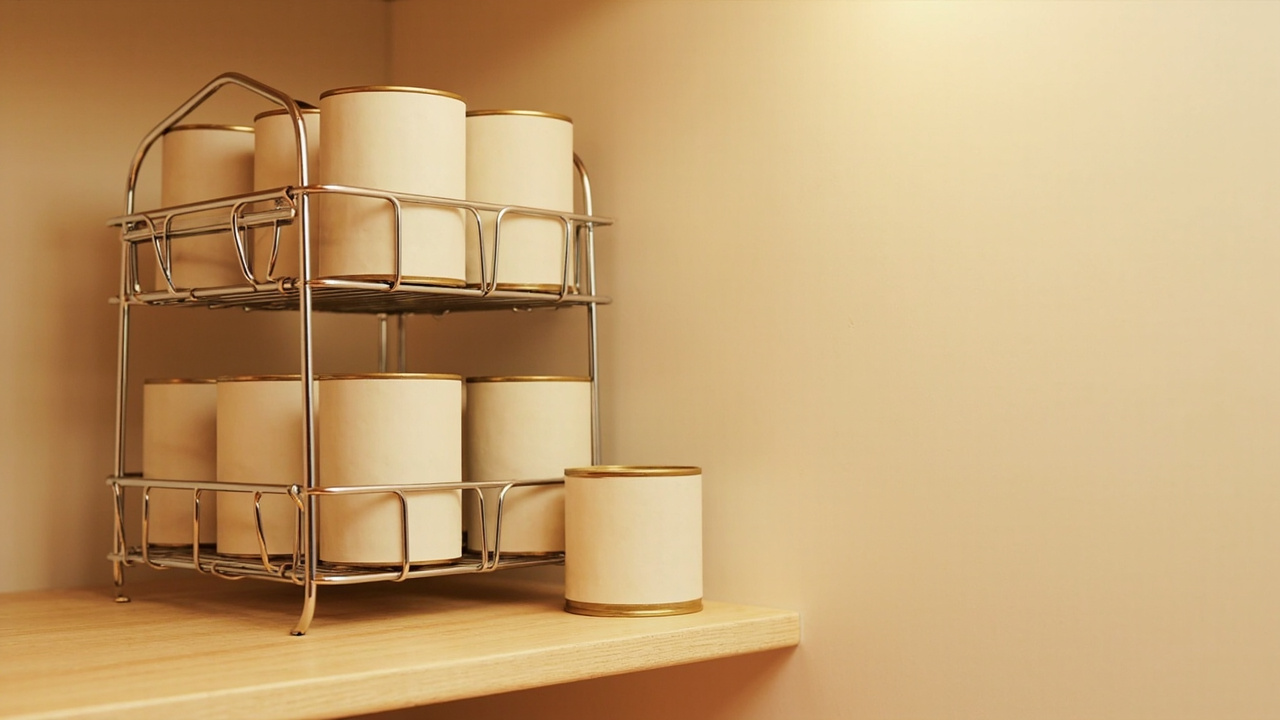
A FIFO can rack solves the expired-can problem by feeding the oldest can to the front so newer stock can’t bury it. For a typical 36-can household, the Deco Brothers Stackable Can Rack ($25.97) handles the job; for 50+ cans, the FIFO Can Tracker 2-Pack ($98.89) rotates cans with no lifting. Match rack to can size — soup/stock/vegetable fit standard 12-oz slots, but #10 cans need a wider wire shelf. For the full pantry map, see the pantry organization hub. For container matching, see pantry storage solutions.
Why Cans Get Lost in the Pantry
The “back row” problem
A 36-can household pushes 18 cans to the back of a single shelf within 6 months. After 12 months, those back cans average 14 months past purchase date, well past the printed best-by date on many canned goods. The fix is FIFO (first-in, first-out): the can you loaded first comes out first. Reference the USDA FoodKeeper app for category-specific shelf-life guidance before discarding any can that looks or smells normal.
Why a flat shelf fails
A flat shelf makes FIFO impossible without manual rotation. Most people rotate by date when they notice — and you only notice the front-row cans, so the back row grows older. A FIFO rack eliminates the manual step because the rack does the rotation.
What changes with a FIFO system
Three wins: (1) no expired cans thrown away ($30-80/year savings for a 2-person household); (2) better inventory awareness — you see what you have before you shop; (3) pantry depth stays consistent. The KonMari category-not-location principle shows up here: cans belong to a can zone.
Pick the Right Rack Type
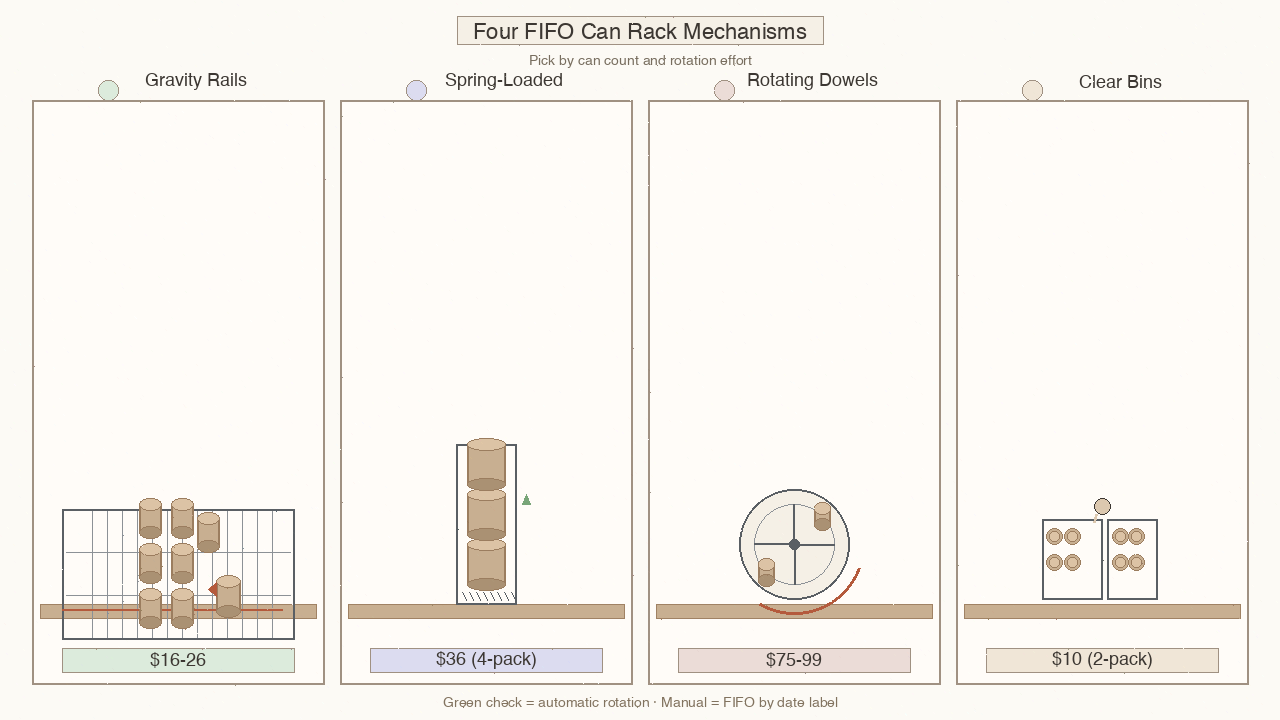
Four mechanisms cover most needs. Pick by can count and whether you want zero-effort rotation or low-cost rotation.
The four FIFO mechanisms at a glance
Gravity rails (slope-front)
A 30-degree slope plus a bottom stop lets cans roll forward as you remove the front can. Best for standard 12-oz cans. The AIYAKA 3-Tier Black ($19.97) and the Kitchen Details 3-Tier Onyx ($16.56) are the entry-tier gravity racks. The Deco Brothers Stackable ($25.97) sits one tier up with stackable expansion.
Spring-loaded dispensers
A spring-loaded base pushes the next can up when you remove one. Best for standard 12-oz cans where gravity alone doesn’t carry enough weight or where you want a single-can-at-a-time dispense. The Simple Houseware 4-Pack ($36.87) gives 4 dispensers you can stack. (For 28-oz tall cans, skip this rack and use a deeper cabinet shelf — see the size-compatibility section.)
Rotating dowels (Lazy-Susan style)
A central rod plus dowels creates a rotating system that feeds cans forward. The FIFO Can Tracker 2-Pack ($98.89) and the Shelf Reliance Cansolidator Plus ($74.99) are the two rotating systems worth comparing. The Cansolidator holds 60 cans per pack; the FIFO Can Tracker holds 54 per pack (108 across 2). The mechanism is automatic — no manual lifting.
Clear bins (FIFO-by-label)
A clear bin lets you see all cans at once and rotate by hand. The Utopia Kitchen Clear 2-Pack ($9.99) is the budget option when rack overhead is too much. Pair with the clear bins vs opaque bins framework.
Organize Cans by Type
Mixing can sizes on one rack breaks the mechanism — a 28-oz can blocks 12-oz cans from rolling forward. Sort by size before loading. The Simple Houseware 4-Pack is rated for standard 12-oz cans only; do not load 28-oz cans into it. For baking-zone cans (pumpkin, sweetened condensed milk) next to flour and sugar, see the pantry baking zone sister guide.
The can-type grid at a glance
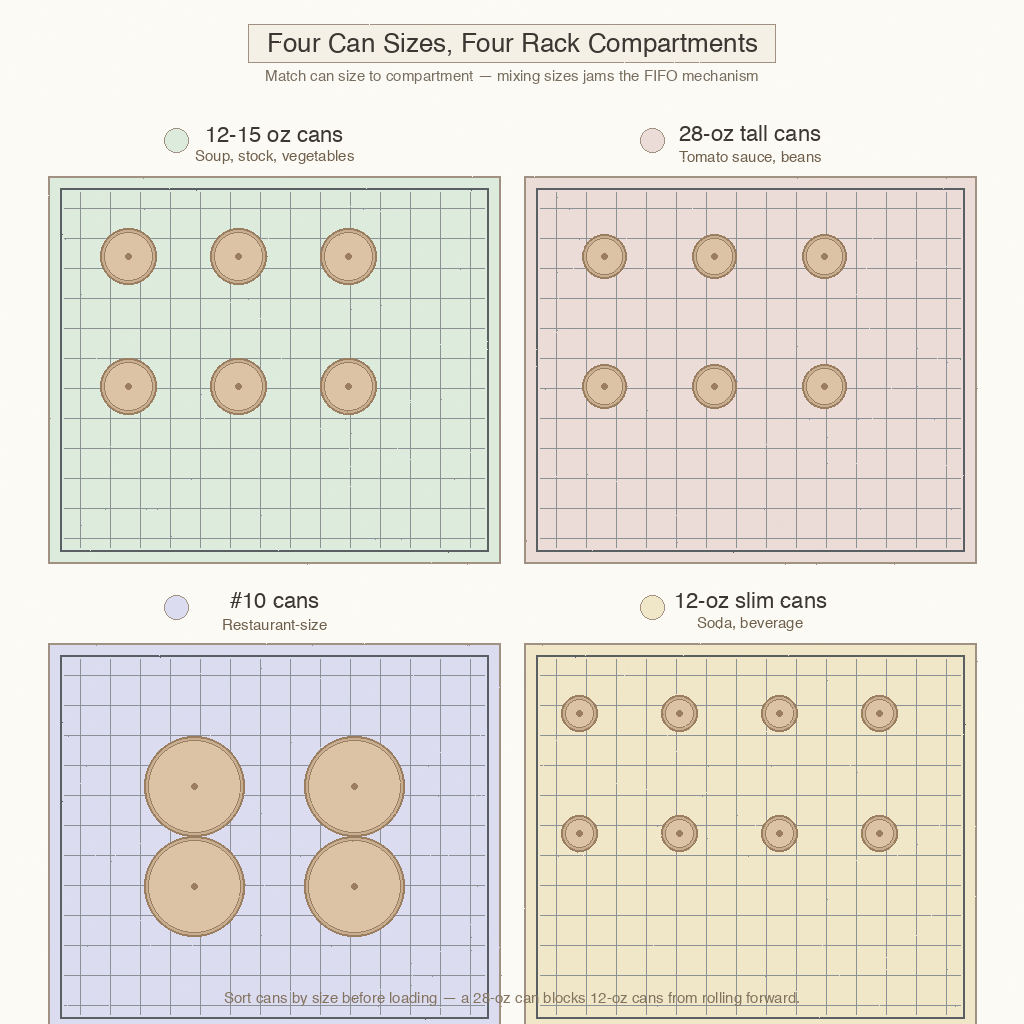
Soup + vegetable + stock (12-15 oz cans)
All standard. Group by category on the same rack row so the back row stays sorted.
Tomato sauce + beans (28-oz cans)
Tall cans need a taller compartment than the Simple Houseware rack provides. Use a deeper cabinet shelf and load 28-oz cans on their side in date order. The Simple Houseware 4-Pack is not designed for 28-oz cans.
Bulk #10 cans (restaurant-size)
Wire shelf required. Standard kitchen racks don’t handle #10 cans. For typical households, skip #10 cans entirely and buy smaller sizes — the dedicated wire-rack market for #10 cans is small. The pantry storage solutions sister article covers wire-shelf sizing.
Soda + beverage (12-oz slim cans)
Standard 12-oz soda cans share the 2.13-inch diameter with soup cans. AIYAKA and Kitchen Details both hold 36 standard cans. Skip a separate soda rack.
Set Up the FIFO Rotation
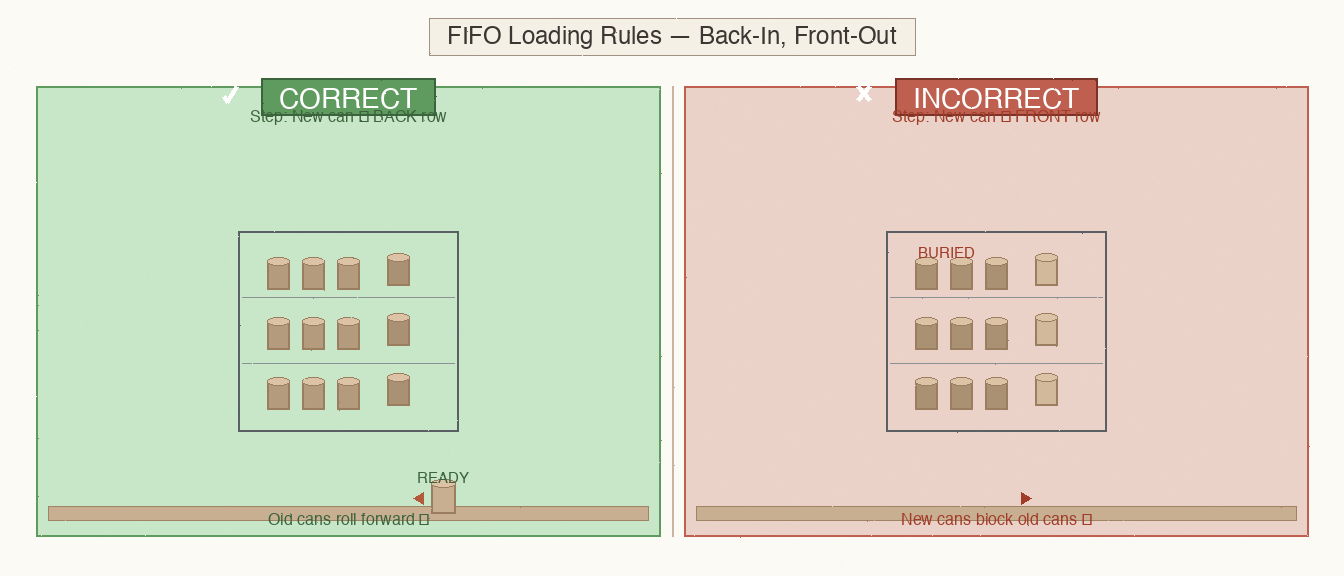
The rack does the heavy lifting, but loading discipline matters. Three rules turn a rack into a FIFO system.
The FIFO loading rules at a glance
The 3-zone inventory method
Front = “now” cans (eat this week). Middle = “next” cans (eat next week). Back = “reserve” cans (1+ month out). Loading new cans always goes in the back row; removing cans always starts at the front. This is the pantry inventory method rhythm applied to cans.
6-month purge cycle
Every 6 months, pull every can out, check the date, and re-stack newest in back. This catches cans you missed in the daily rotation — missing this step is the most common way multi-year-old cans end up in the back row.
Quarterly bulk check
For households that buy in bulk (Costco packs of 36-48 cans), do a quarterly check before re-stocking. Move any can within 3 months of best-by to the front row. The pantry bulk overflow sister article covers Costco/Sam’s Club bulk-buy integration.
Layout by Pantry Size
This is Layer 1 of the can-zone system: size first, then constraints. Match the rack to your pantry’s actual shelf dimensions before you buy.
Three pantry sizes at a glance
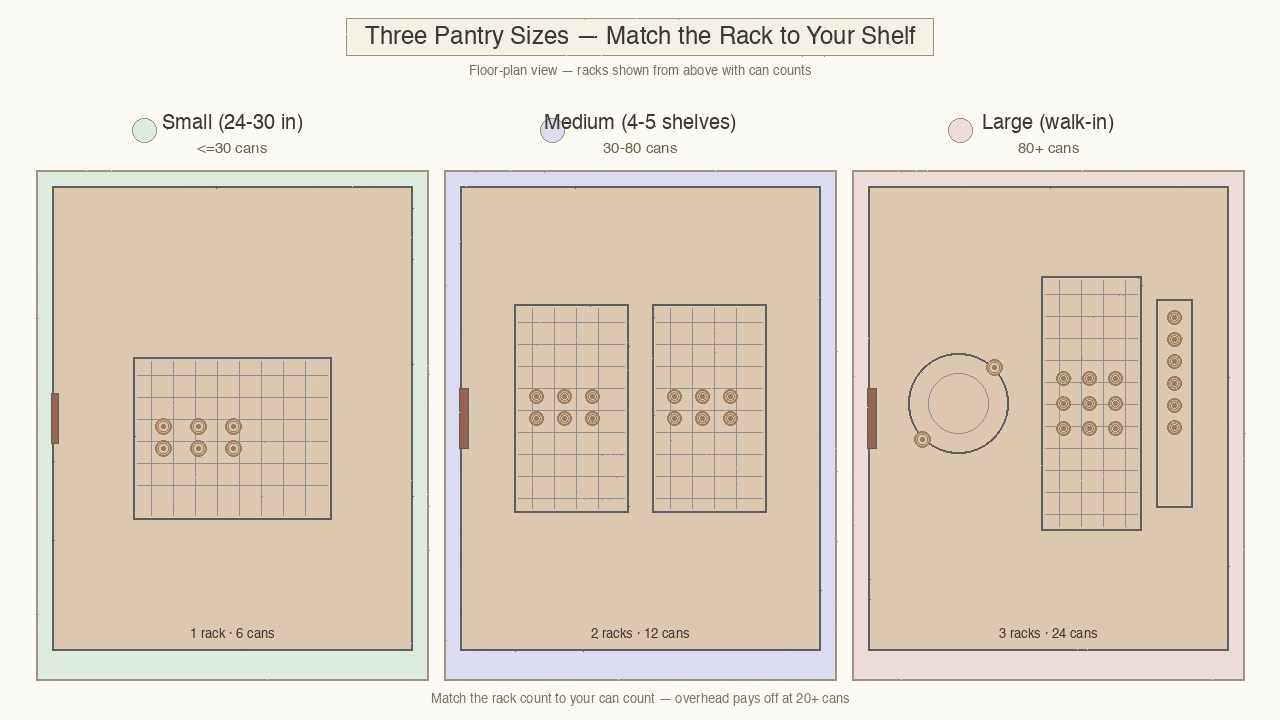
Small pantry (24-30 inch cabinet, ≤30 cans)
Use ONE 3-tier gravity rack — the Kitchen Details Onyx ($16.56) or the AIYAKA Black ($19.97). Skip the rotating system — overhead is too high for the can count. Place on the bottom shelf (heavy cans go low rule from the pantry zone system). The small pantry organization sister article covers 24-30 inch cabinet geometry. For matching bin dimensions to shelf depth, see how to choose storage bins.
Medium pantry (4-5 shelves, 30-80 cans)
Stack TWO 3-tier racks side-by-side, OR use the FIFO Can Tracker 2-Pack ($98.89) on one shelf for automatic rotation. For 28-oz tall cans, use a separate deeper cabinet shelf with date-ordered loading (the Simple Houseware 4-Pack is sized for standard 12-oz cans only).
Large pantry (walk-in or 8+ shelves, 80+ cans)
Combine: rotating FIFO rack (the Cansolidator Plus at $74.99 or the FIFO Can Tracker 2-Pack at $98.89) on the bottom shelf for standard cans, deeper cabinet shelf for 28-oz tall cans on the middle shelf, and the Utopia Kitchen Clear 2-Pack ($9.99) for snacks/soup on the upper shelf.
Constraint Guide
Layer 2 maps real limits onto the same racks. Each scenario reuses picks so you don’t need a second cart.
If your pantry depth is <12 inches
Skip the rotating racks (they need 13-15 inch depth). Use a 4-tier narrow stackable like the Simple Houseware 4-Pack ($36.87) at 5.8-inch width per dispenser. Pair with the Utopia Kitchen Clear 2-Pack ($9.99) as a budget overflow bin for date-stamp checks.
If cans arrive from bulk (Costco/Sam’s Club)
Skip the Deco Brothers (36-can max). Get the FIFO Can Tracker 2-Pack ($98.89) at 108-can total capacity. For under 50 cans per Costco run, start with the Deco Brothers ($25.97) at 36-can capacity and add a second unit when overflow returns. Pair with the pantry bulk overflow sister article for the rest of the Costco-run integration.
If you rent (no drilling)
Stick with freestanding racks. The Deco Brothers, AIYAKA, Kitchen Details, and FIFO Can Tracker are all freestanding.
If cans include #10 restaurant-size
Skip all standard kitchen racks for #10 storage. The Shelf Reliance Cansolidator Plus ($74.99) holds 60 cans but is sized for 12-15 oz, not #10. For standard 12-oz cans, the Simple Houseware 4-Pack ($36.87) racks each hold up to 12 standard 12-oz cans with a sloped design (see the size guide above for the rack-vs-can size compatibility rules). For most households, skip #10 cans entirely and buy smaller sizes.
If budget is under $20
Use the Utopia Kitchen Clear 2-Pack ($9.99) plus manual rotation every 2 weeks. You give up automatic FIFO but spend 90% less. If you need racks but not mechanism, the AIYAKA Black ($19.97) is a 36-can gravity rack at the upper edge of the $20 ceiling.
If you have only 5-10 cans
No rack needed. A single shelf with cans in date order works fine. The Kitchen Details Onyx ($16.56) at 3-tier handles 12-18 cans if you anticipate growth, but a shelf with Utopia Kitchen Clear 2-Pack ($9.99) bins for date grouping works fine below 10. Rack overhead pays off at 20+ cans. The declutter fast method covers under-20-can households.
What You’ll Need: 7 Racks for the Can Zone
Seven picks cover every pantry size and budget. Mix and match for medium/large pantries.
P1 — Deco Brothers Stackable Can Rack — Hero for 36-can households
$25.97. Best mid-tier gravity rack. Stackable for 72-can households.
P2 — FIFO Can Tracker 2-Pack — Best for 50+ cans
$98.89. Patented rotating dowel system. Holds 108 cans across 2 packs. The only system that auto-rotates without manual lifting.
P3 — AIYAKA Can Rack Organizer 3-Tier Black — Best budget gravity
$19.97. Holds 36 standard cans. 30-degree slope + bottom stop. Wider footprint than Kitchen Details; priced ~$3.41 (17%) higher for the same 36-can capacity.
P4 — Kitchen Details 3-Tier Can Organizer Onyx — Best value
$16.56. Open-front design, 14.5×11.5×11 inches, fits narrow cabinets where AIYAKA doesn’t. 17% ($3.41) cheaper than AIYAKA at the same 36-can capacity.
P5 — Simple Houseware 4-Pack Soda Can Dispenser — Best for 12-oz multi-pack
$36.87. 4-pack chrome dispensers, each 8.5 inches tall, each compartment holds up to 12 standard 12-oz cans. Best for standard soda/soup can households; not compatible with 28-oz tall cans.
P6 — Shelf Reliance Cansolidator Plus — Best premium rotating
$74.99. Patented FIFO rotating system. Holds 60 cans per pack.
P7 — Utopia Kitchen Clear Can Organizer 2-Pack — Best budget clear bin
$9.99. 2-pack clear acrylic bins. Holds 24 standard 12-oz cans. Manual FIFO by date label.
Common Mistakes
Mistake 1: Buying a rack without measuring pantry depth
The Deco Brothers needs 17.5-inch width and 11.5-inch depth. The FIFO Can Tracker 2-Pack needs 16-inch width and 16-inch depth (per the Amazon listing dimensions). Measure your shelf clearance before ordering.
Mistake 2: Loading new cans in front instead of back
New cans go in BACK. This is the entire point of FIFO. If you load in front, you’re pushing older cans to the back where they’ll expire.
Mistake 3: Mixing can sizes on one rack
A 12-oz soup can and a 28-oz tomato sauce can do NOT mix. The 28-oz will block the 12-oz from rolling forward and break the gravity mechanism. Sort by size first.
Mistake 4: Ignoring the date
FIFO racks only work if you ACTUALLY use the cans in rotation. If you keep loading without removing, you defeat the system. Pick a 2-week reminder: “Friday is can rotation day.”
Mistake 5: Skipping the 6-month purge
Back-row cans accumulate. Without a 6-month full-purge, the back row will hold 18-month-old cans that nobody saw on the shelf-by-shelf sweep.
Related Guides
- Pantry Organization Hub — umbrella for all 5 pantry zones
- Pantry Inventory Method — 3-zone rotation system applied to all canned/dry goods
- Pantry Storage Solutions — broader storage across all zones
- Kitchen Pantry Hub — full kitchen pantry system overview
- Kitchen Organization Hub — broader kitchen storage, decluttering, and workflow systems
Key Takeaways
- A FIFO rack eliminates the back-row rot problem flat shelves create.
- Pick by can count: <30 = budget gravity; 30-80 = stack or rotating; 80+ = rotating 2-pack.
- Group cans by type before loading — soup/veg on one rack, tall cans on another.
- Load new cans in BACK. Remove from FRONT. This is FIFO discipline.
- The 6-month full-purge catches cans you missed.
- Skip the rack if you have <20 cans — overhead pays off at 20+.
- Measure pantry depth BEFORE buying.
- For under-$20 budgets, manual rotation with the Utopia Kitchen Clear 2-Pack works.