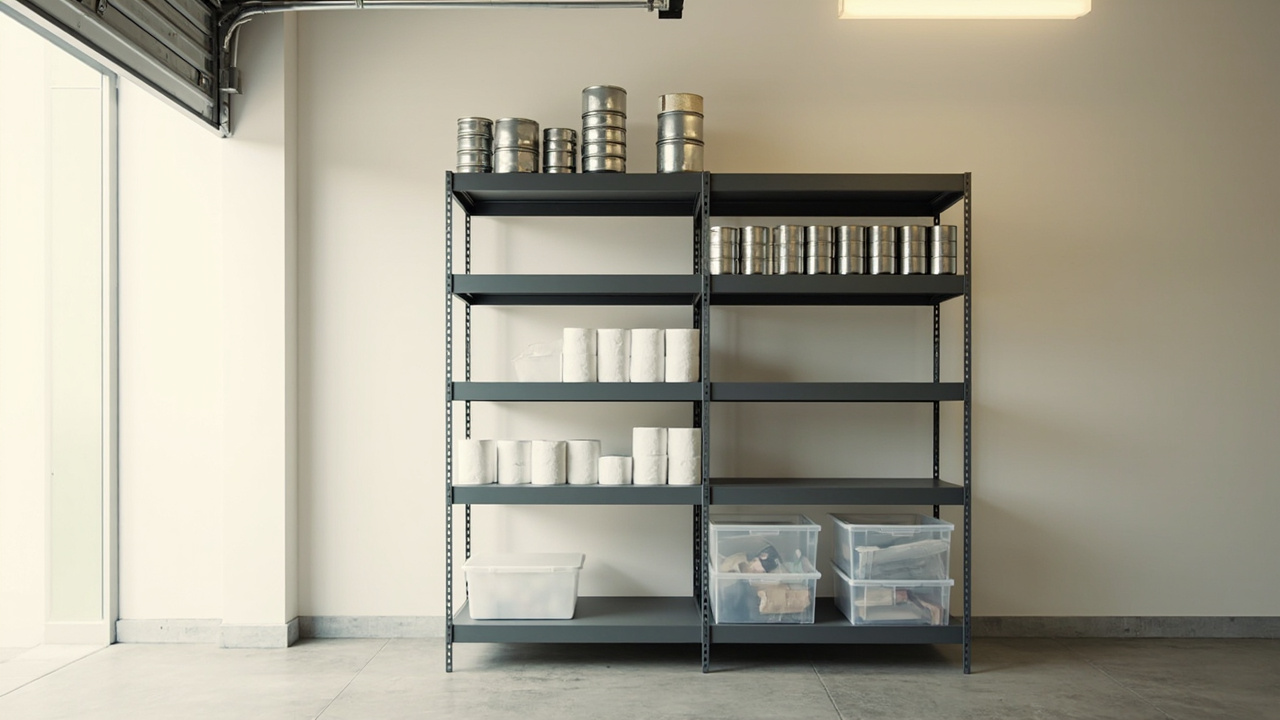
A Costco or Sam’s run once a month leaves the daily pantry over-stuffed and pushes overflow into garage shelves, hallway closets, under-stairs nooks, basement corners, and mudroom racks. This article gives you a 4-zone overflow framework — Bulk-Decant, Paper-Goods, Backup-Stock, and Overflow-Placement — plus a Costco-run cadence that decants what’s needed and leaves the rest in original packaging. Every overflow zone maps to a container and shelf, so the paper towels stop stacking on the dryer and the 12 cans of tuna don’t disappear for a year.
Quick answer
A monthly Costco run leaves the daily pantry over-stuffed. The fix is the 4-zone overflow framework: decant daily-use staples into airtight bins on day 1, leave occasional-use Costco bags sealed in a dry overflow zone, rotate canned backup stock with a FIFO rack, and place heavy paper goods on a garage or hallway rack. Total setup: $200-250.
Why Costco overflow breaks the standard pantry
Standard pantry plans — the 5-zone daily system, shelf-depth matching containers, zone-based daily rotation — assume you shop weekly at a regular grocery store and buy what fits the shelf. Costco trips invert that: 6-12 months of paper goods, 20-50 lb of bulk dry goods, 24-48 cans in one trip. The result is overflow that spills into adjacent spaces not designed for storage.
Three failure modes show up: overflow without a defined spot, bulk decanted all at once (identical bins hide expiry), paper goods shoved in a damp basement (mildew in 2-3 months, you re-buy what you already own). The fix is a separate overflow zone with its own rules.
The 4-zone overflow framework
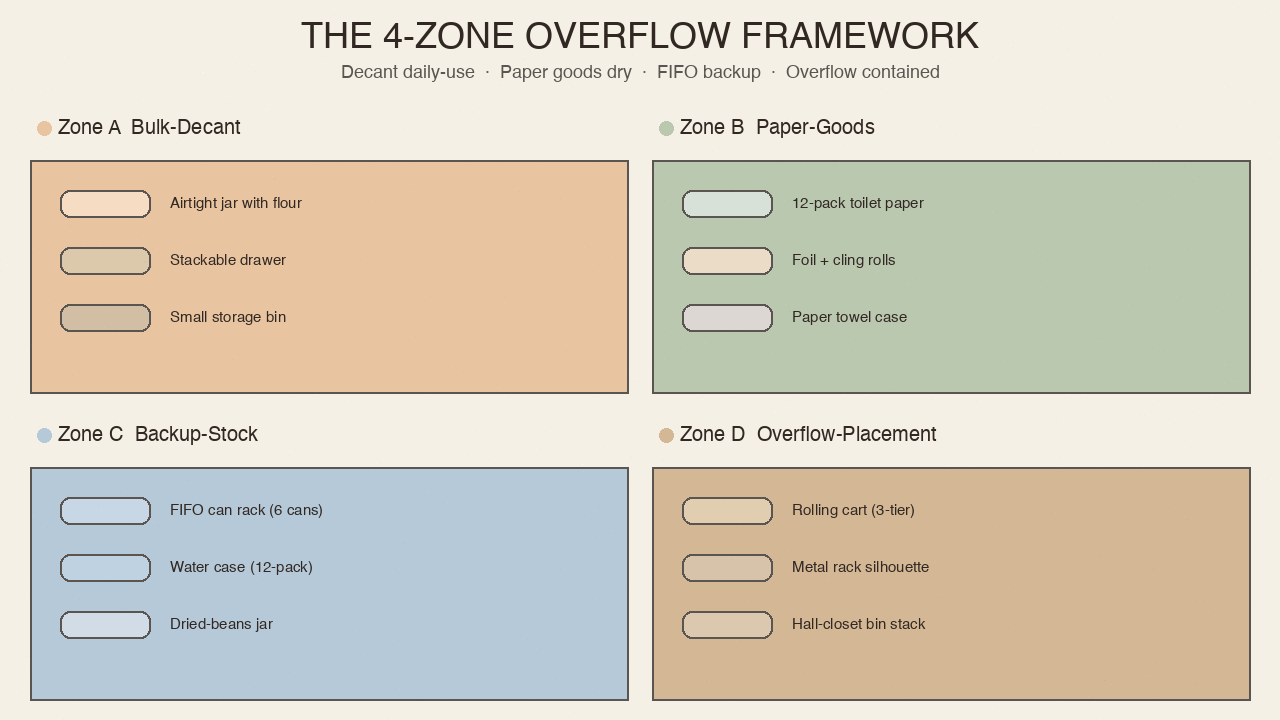
The 4-zone framework maps Costco/Sam’s bulk into four placement categories. Each zone has a container type, a placement rule, and a rotation rhythm.
Zone A: Bulk-Decant — daily-use staples in airtight containers
After a Costco run, decant flour (50 lb into 6× 5-lb jars), sugar (25 lb into 4× 5-lb jars), rice (20 lb into 6× 3-lb jars), and cereal (12 boxes into 6 decanted + 6 unopened in overflow). Bulk-decant keeps daily ingredients reachable; the unopened overflow stays sealed in the Overflow-Placement zone.
The IRIS USA Large Stackable Drawer ($54.99) is the workhorse — clear sides, pull-out drawer, depth for a 5 lb flour bag with headroom. For shallower shelves, the mDesign Stackable Plastic Bin ($72.99) handles baking powder, salt, and smaller dry-goods packets.
Zone B: Paper-Goods — TP, paper towels, ziplock bags
Costco/Sam’s paper goods come in 12-30 roll packs that don’t fit a standard pantry: toilet paper, paper towels, ziplock bags, foil and cling wrap, paper plates. Two hard rules: dry and reachable. Paper + moisture = mildew, and you swap a roll every 2-4 weeks so the swap should not require a ladder.
IRIS USA Stackable Bins ($54.99) hold a full 12-roll TP pack with room to spare; the see-through design means you can spot the empty carton at a glance. Stack the second tier with foil and cling wrap in the mDesign Stackable Plastic Bin ($72.99). The bathroom linen closet guide covers the same stackable-bin pattern when paper goods spill into the bathroom-adjacent hallway.
Zone C: Backup-Stock — canned goods, bottled water, shelf-stable backup
Shelf-stable backup that lasts 6-24 months: canned vegetables and fruits (24-48 cans), canned proteins (12-24 cans), dried beans (10-20 lb), bottled water cases. Backup-stock rotates slowest — FIFO on cans, oldest-first on water.
The rotation rule matters most here. The Simple Houseware Stackable Can Rack ($25.97) loads new cans at the back and dispenses from the front, so older cans can’t hide behind newer ones. For bottled water cases, the Whitmor 4-Tier Heavy Duty Storage Shelving ($79.90) holds 12+ water cases plus 200+ cans on the same rack.
Zone D: Overflow-Placement — where the rest actually goes
Destination spaces that absorb what doesn’t fit in Zones A-C: garage metal shelving, basement corner shelves, under-stairs nooks, hallway linen closets, mudroom racks, laundry-room over-washer shelves, and under-bed storage bins. Each placement has its own constraint: moisture, weight capacity, accessibility.
The SONGMICS 3-Tier Metal Storage Cart ($39.99) handles overflow that needs to move — cleaning supplies plus paper goods that roll between mudroom and laundry room. For fixed overflow, the Whitmor 4-Tier Heavy Duty Storage Shelving ($79.90) anchors 200+ cans plus 12 cases of paper towels in a 4×2 footprint.
Costco-run cadence: when to decant, when to leave sealed
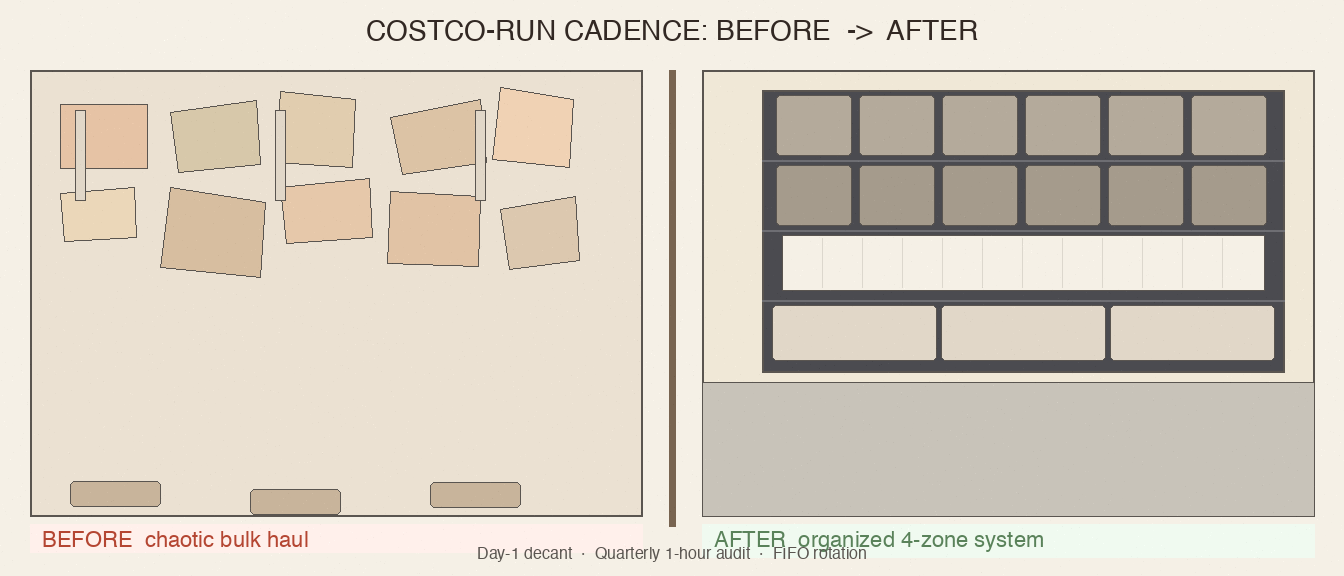
Costco/Sam’s runs happen on a 4-6 week cadence for most households. The rule: decant on day 1 what you reach for daily; keep sealed what you reach for less than monthly; audit quarterly.
Day 1 — Decant daily-use staples immediately
Flour, sugar, coffee, cereal, rice, oats — the dry-goods you reach for daily — come out of bulk packaging into airtight daily containers. The empty Costco bag goes to recycling. This step takes 20-30 minutes for a typical Costco haul.
Use the IRIS USA Large Stackable Drawer ($54.99) for the working 5-7 lb decant and leave sealed backup bags in the overflow zone. Label every decanted container with the open date using a Brother P-Touch label maker.
Keep sealed 6-12 months — low-frequency items stay in original packaging
Occasional-use items — specialty flour, holiday baking supplies, backup cleaning products, specialty canned goods — stay sealed in the original Costco or Sam’s bag inside an overflow bin. You only decant when you actually open them, and the original packaging becomes the expiry label.
Decanting all Costco items at once creates the “2024 cans of tuna” problem where everything looks identical. The KonMari category-not-location principle applies: same-category items stay together whether decanted or sealed.
Quarterly — 1-hour overflow audit
Every 3 months, walk the overflow zone with a trash bag. Check expiry dates on backup-stock cans, rotate FIFO on bottled water, swap out anything past best-by, and refresh open-date labels on decanted dry goods. The 1-hour audit prevents the “I forgot I bought 12 cans of tuna in 2024” loss that costs $30-50 per year.
The declutter maintenance routine breaks this into a quarterly rhythm. The pantry inventory method covers restock cadence and the digital-tracking half.
Layout by Placement Space
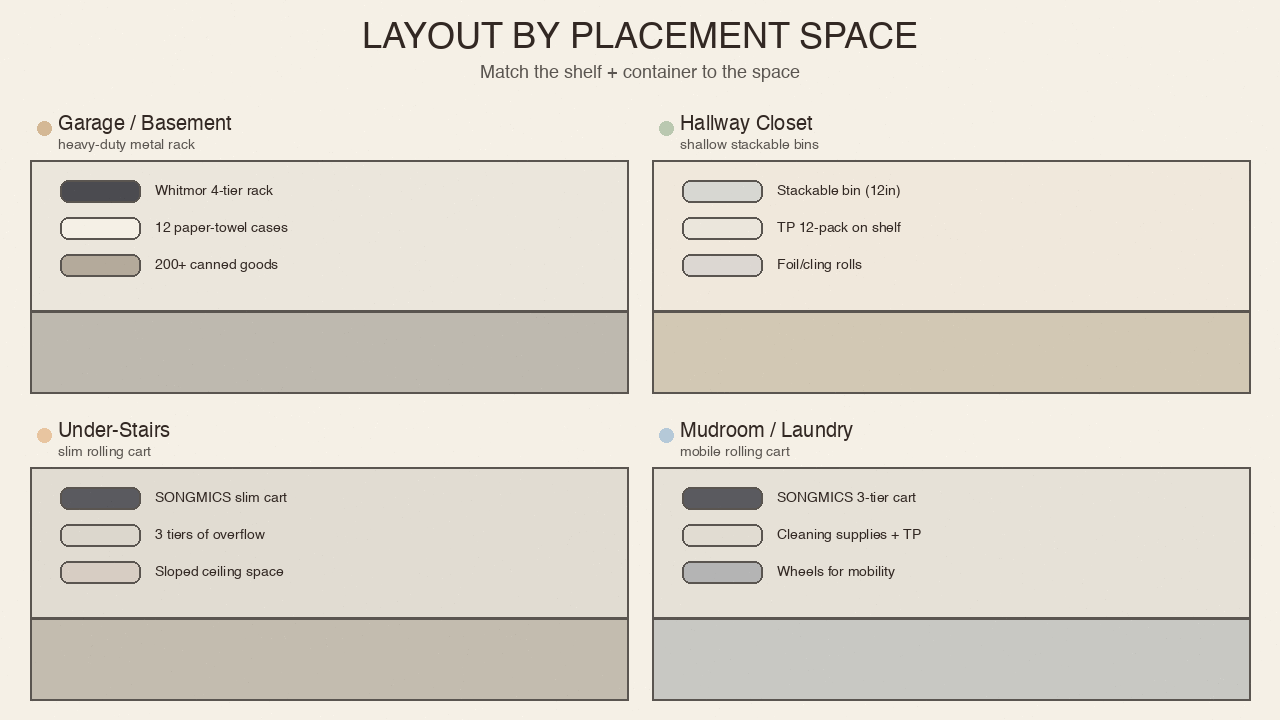
The 4-zone framework works anywhere, but placement choices change based on where the overflow actually lives. Match shelf and container to the space.
Garage / basement — heavy-duty metal shelving
The most common overflow destination. A Whitmor 4-Tier Heavy Duty Storage Shelving ($79.90) holds 8-12 cases of paper goods or 200+ cans at 400 lb per shelf. Damp rule: powder-coated metal only, never wood or MDF. Wood racks absorb basement moisture and mildew in 6-12 months.
Measure garage door-swing and ceiling height before buying. A 72-inch rack won’t fit under a 7-foot garage door header with the door open. The Whitmor 4-Tier rack at 54 inches tall clears a 7-foot garage-door header and still fits standard 8-foot ceilings.
Hallway closet / linen closet — shallow stackable bins
The mDesign Stackable Plastic Bin ($72.99) is shallow enough for an 8-12 inch shelf depth and stacks 2-3 high without tipping. Standard bedroom closets run 12 inches deep, hallway closets run 16-20 inches — measure depth before buying.
The bathroom linen closet guide covers the same shallow-shelf stackable-bin pattern when paper goods spill from kitchen into bathroom-adjacent hallway space.
Under-stairs / corner nook — Lazy Susan or slim cart
A slim cart on wheels rolls out for quarterly audits and rolls back when not in use. The SONGMICS 3-Tier Metal Storage Cart ($39.99) is 24 inches wide and fits most under-stairs nooks with the wheels adding 4 inches of clearance. The spice organization guide covers the same corner-nook pattern for spice overflow.
Mudroom / laundry-room — mobile rolling cart
The SONGMICS 3-Tier Metal Storage Cart ($39.99) handles overflow that needs to move — cleaning supplies on the bottom, paper goods in the middle, laundry detergent on top. The same 3-tier cart pattern is adapted for detergent and dryer sheets in a small laundry room.
Constraint Guide: pick your overflow setup
Five common scenarios drive the overflow setup. Each maps to a different product mix.
If you’re renting / no-drill
Skip wall-mounted racks. Modular stackable bins and mobile carts cover rental overflow without damaging drywall or tile. The mDesign Stackable Plastic Bin ($72.99) stacks on any shelf with no install, and the SONGMICS 3-Tier Metal Storage Cart ($39.99) rolls where you need it.
If you have a damp basement / garage
Powder-coated metal shelving or sealed plastic bins only. Wood and MDF absorb basement moisture and mildew within 6-12 months. The Whitmor 4-Tier Heavy Duty Storage Shelving ($79.90) is powder-coated steel rated for damp environments. For canned goods, the IRIS USA Large Stackable Drawer ($54.99) seals cans from moisture when humidity spikes.
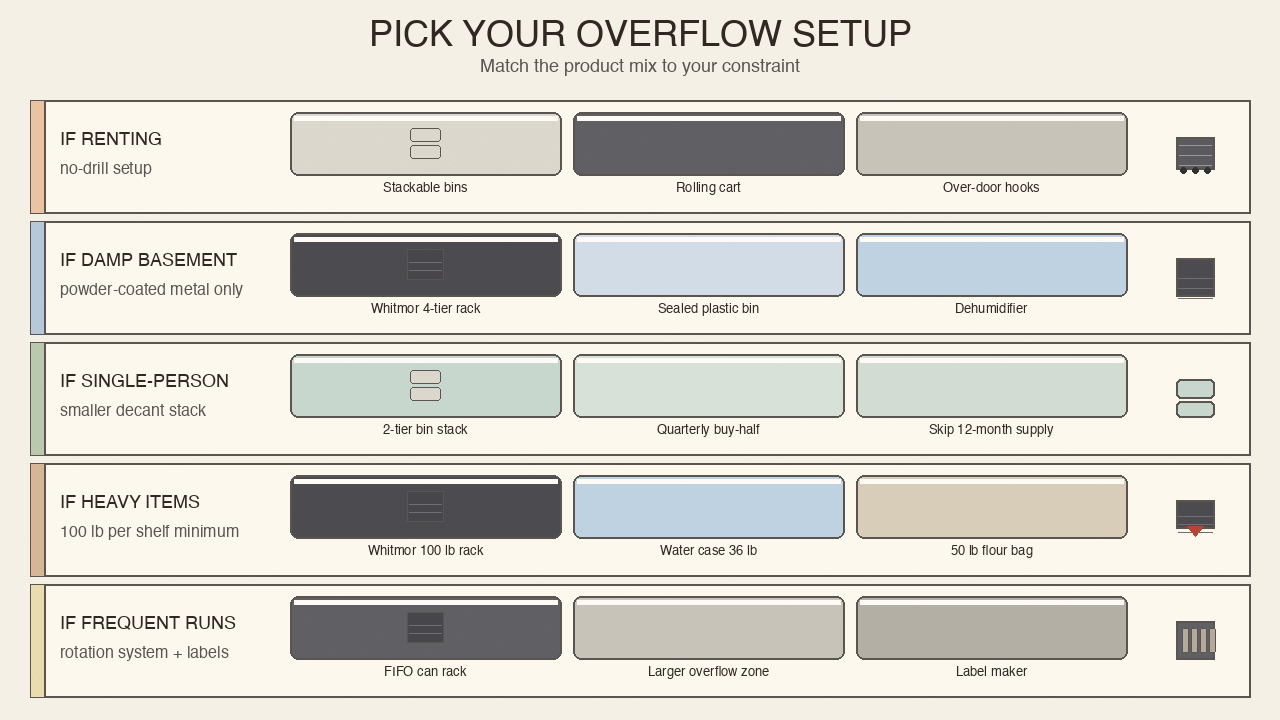
If you’re a single-person household
Smaller bulk quantities, decant on demand rather than monthly. Skip the Whitmor 4-Tier for a 2-tier IRIS USA Stackable Bins ($54.99) stack that holds 4-6 weeks of paper goods and canned backup.
If you have heavy items (water cases, 50 lb flour)
Heavy-duty metal shelving with 100+ lb per shelf capacity. The Whitmor 4-Tier handles 12 cases of bottled water (432 lb total) plus 200+ cans of backup stock. For flour and sugar, the IRIS USA Large Stackable Drawer ($54.99) holds 5 lb at a time; offload the 50 lb bag to the rack and decant into the drawer as you go.
If you make frequent Costco runs (2×/month)
Bigger overflow zone, label-maker for rotation, written restock list. The Simple Houseware Stackable Can Rack ($25.97) handles rotation when cycling through cans faster than quarterly. Pair with IRIS USA Stackable Bins ($54.99) for the bigger zone. Add a Brother P-Touch label maker for open-date labels.
What you’ll need: 6 products for the 4-zone overflow system
Six products cover the four zones. Total setup: about $230 for a year of Costco runs.
- P1 (Bulk-Decant): IRIS USA Stackable Plastic Storage Bins ($54.99) — paper-goods cases stay visible and pull-forward.
- P2 (Backup-Stock + Overflow): Whitmor 4-Tier Heavy Duty Storage Shelving ($79.90) — 400 lb per shelf for garage or basement.
- P3 (Overflow-Placement): SONGMICS 3-Tier Metal Storage Cart ($39.99) — mobile rolling cart for mudroom or laundry.
- P4 (Bulk-Decant + Paper-Goods): mDesign Stackable Plastic Storage Bin ($72.99) — shallow shelf depth, see-through drawer.
- P5 (Backup-Stock): Simple Houseware Stackable Can Rack ($25.97) — FIFO bottom-up dispenser for canned backup.
- P6 (Bulk-Decant): IRIS USA Large Stackable Drawer ($54.99) — pull-out drawer for 5 lb flour and sugar decants.
For a deeper walkthrough of bin selection, the clear bins vs opaque bins compare covers see-through trade-offs in detail. For plastic vs fabric, the plastic bins vs fabric bins compare covers the same pick for paper-goods storage.
Common Mistakes
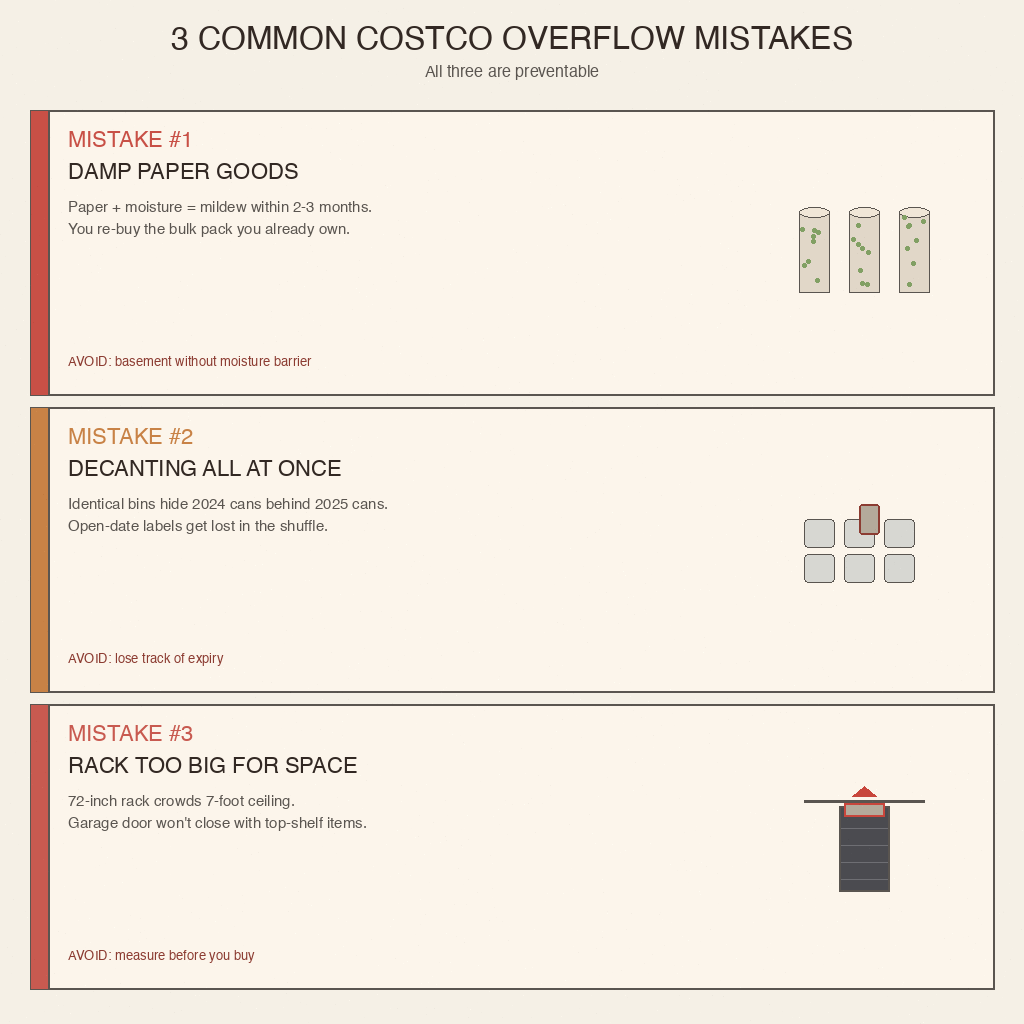
Three mistakes show up in every Costco overflow system that fails within 6 months.
Mistake #1 — Paper goods in a damp basement without moisture barrier
Paper + moisture = mildew within 2-3 months, and you re-buy the Costco pack you already own. Fix: powder-coated metal shelving like the Whitmor 4-Tier, or sealed plastic bins like the IRIS USA Stackable Bins. Wood racks absorb basement moisture and mildew in 6-12 months. If your only option is a damp basement, run a dehumidifier first.
Mistake #2 — Decanting all Costco items at once
Decanting everything creates identical bins where 2024 cans hide behind 2025 cans, and 6-month-old flour loses its open-date label. Fix: decant daily-use staples on day 1 only, leave occasional-use items sealed, and label every decanted container with an open-date Brother P-Touch label. The KonMari category-not-location principle applies: same-category items stay together whether decanted or sealed.
Mistake #3 — Buying overflow shelving before measuring the space
Measure depth, height, and door-swing before buying any rack. The Whitmor 4-Tier at 54 inches tall fits 8-foot garage ceilings and clears 7-foot headers. Standard bedroom closets run 12 inches deep; hallway closets run 16-20 inches. The small-pantry organization guide walks through the same measurement-first pattern.
When to call a pro
Most Costco overflow setups don’t need a contractor. The exception is built-in garage shelving with wall anchors, basement sub-floor moisture mitigation, or mudroom cabinetry. For those, a local handyman at $50-75/hour covers 4-8 hours of work. The 4-zone framework above handles the 90% case without a pro.
Related Guides
Start with the pantry organization hub for the full room system, then use these focused guides:
- Master 5-zone daily pantry system — the daily-use counterpart to this overflow guide.
- Pantry zone setup method — 5-step zone assignment for the daily-use shelves.
- Pantry inventory method — FIFO rotation + restock cadence.
- Pantry storage solutions — bin, jar, and rack pick by shelf depth.
- Kitchen pantry organization — daily canned + dry bulk organization for the kitchen side.
- Storage bins decision guide — full bin selection walkthrough.
- Declutter maintenance routine — quarterly audit rhythm for overflow.
Key takeaways
- Decant daily-use staples on day 1; leave occasional-use items sealed in original packaging.
- The 4-zone framework covers Costco and Sam’s bulk in any house.
- Paper-goods zones must be dry; moisture + paper = mildew in 2-3 months.
- Backup-stock uses FIFO rotation; a 1-hour quarterly audit prevents the 2024-can-of-tuna loss.
- Heavy-duty metal shelving for damp basements and garages; never wood or MDF.
- Measure depth, height, and door-swing before buying any rack.
- Renters use modular stackable bins + mobile carts (no drill, no install).