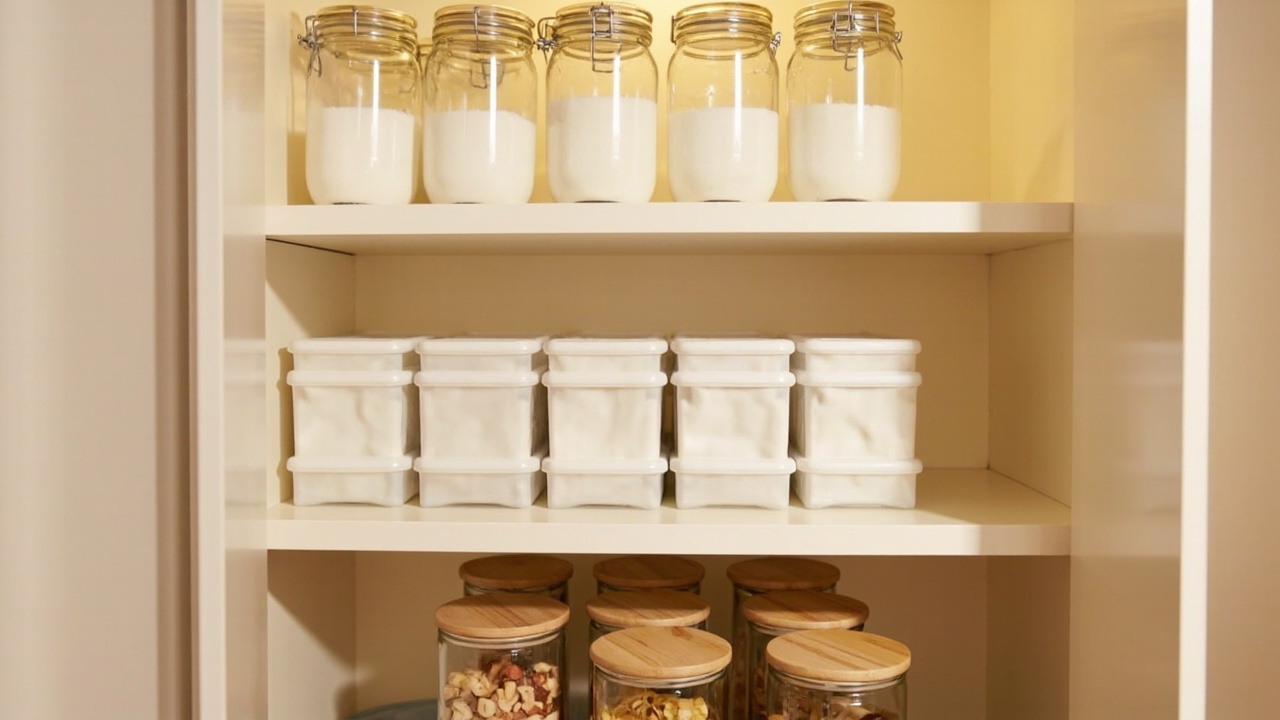
You don’t have to decant every package to get an airtight, label-friendly pantry. Keep unopened backups in original boxes; decant only what you reach for weekly — flour, sugar, cereal, pasta, rice, snacks — into matching airtight containers sized for your shelves. Square + clear + clamp-lid wins on density and visibility; opaque jars earn their place for visual calm. Budget $30-$80 covers a 14-24 piece set that handles a 3-shelf reach-in pantry. If you’re starting from a full pantry, work through declutter fast first — decanting a chaotic pantry just gives you 12 matching jars of clutter.
Why Airtight Matters (and What Decanting Actually Solves)
Decanting gets a reputation for being an aesthetic flex. It’s not. In our experience, three things airtight containers consistently solve:
- Pest exclusion. Weevils, Indian meal moths, and pantry beetles arrive in flour, rice, and birdseed — original cardboard and thin plastic don’t keep them out.
- Moisture + freshness. Hard lids with silicone gaskets cut oxygen exchange; brown rice stays fresh 6 months vs 2 months in the original bag.
- Inventory signal. A clear jar that’s half-empty tells you at a glance you’re low. Original packaging rarely does.
What decanting does not solve: it’ll never disguise that you have three open bags of chocolate chips. For that you need an inventory method — see the pantry inventory method for the operating system behind visible contents.
Container Materials Compared (Round vs Square, Glass vs Plastic)
Glass canisters — best for dry goods you can see
Clamp-lid glass (Fido-style or 78oz square) seals airtight, doesn’t absorb odors, and looks intentional on open shelves. Heavy (5-8 lb when full of flour), breakable, and bulky on density — a 78oz jar eats 8 inches of shelf depth. The Vtopmart Glass Jars 7-Pack with Bamboo Lids earn the visible top-shelf spot when aesthetics matter more than cost.
Plastic airtight — best for bulk + weight
BPA-free plastic sets (24-pc PRAKI or CHEFSTORY 8-pc class) are the workhorses of a reach-in pantry. Light, cheap, stackable, and most pass the “drop one on the floor and don’t cry” test. Slightly less airtight long-term (gaskets wear in 12-18 months) and prone to stain from tomato sauce or turmeric. See clear bins vs opaque bins for the visibility trade-off in detail.
Square vs round — square wins on shelf density
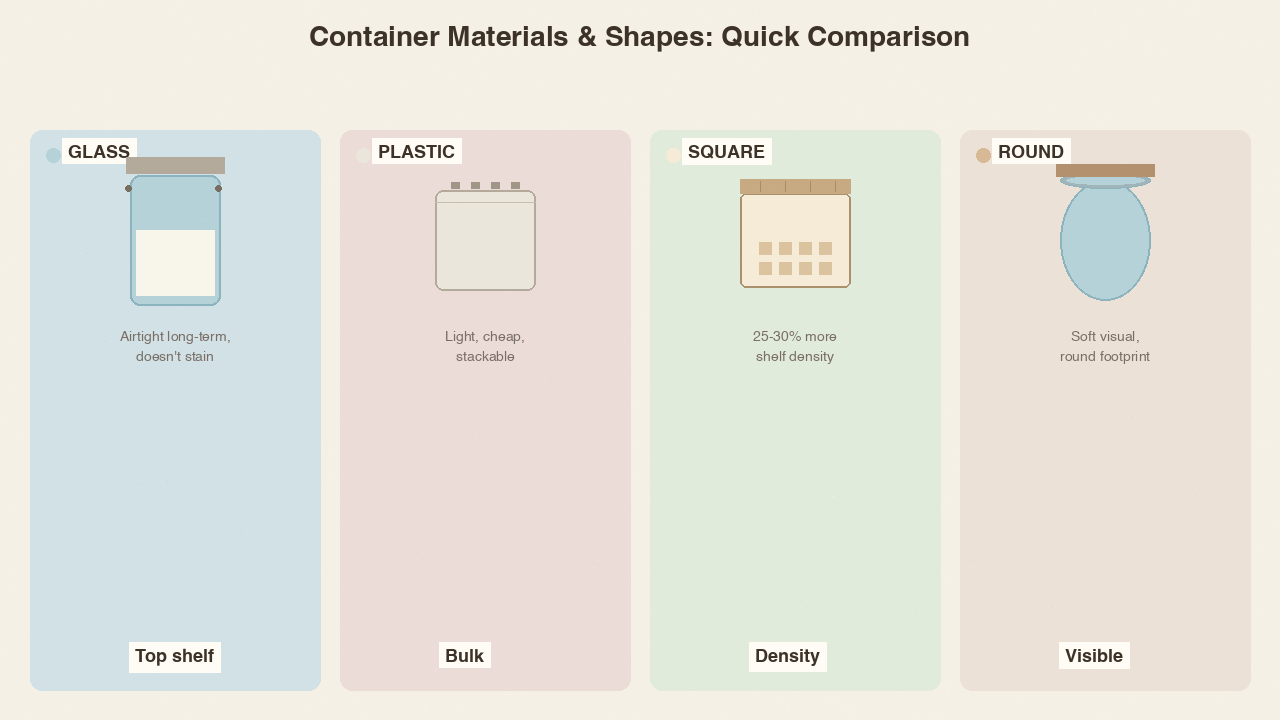
Square containers pack 25-30% more volume per linear shelf inch than round. If your pantry has fixed-depth shelves (16” or less), square is the default. The ComSaf Square 78oz 3-Pack is the density-conscious pick when shelf real estate matters more than visual softness.
Clear vs opaque — clear for staples you use weekly, opaque for visual calm
Opaque bins hide visual noise (bags of chips, snack wrappers) but defeat the inventory signal. Reserve opaque for long-shelf-life items you don’t track — bulk toilet paper, water bottles, pet food overflow. For weekly staples, clear wins.
Size Guide by What You’re Storing
Small (8-16 oz) — spices, baking powder, salt
Stack 12-18 on a single 12” shelf. Square 8-oz jars are the universal size; avoid round for spices (waste 30% of the shelf footprint). Spices are the exception to the decanting rule (see Common Mistakes below).
Medium (32-64 oz / 1-2 quart) — flour, sugar, brown rice, pasta, cereal
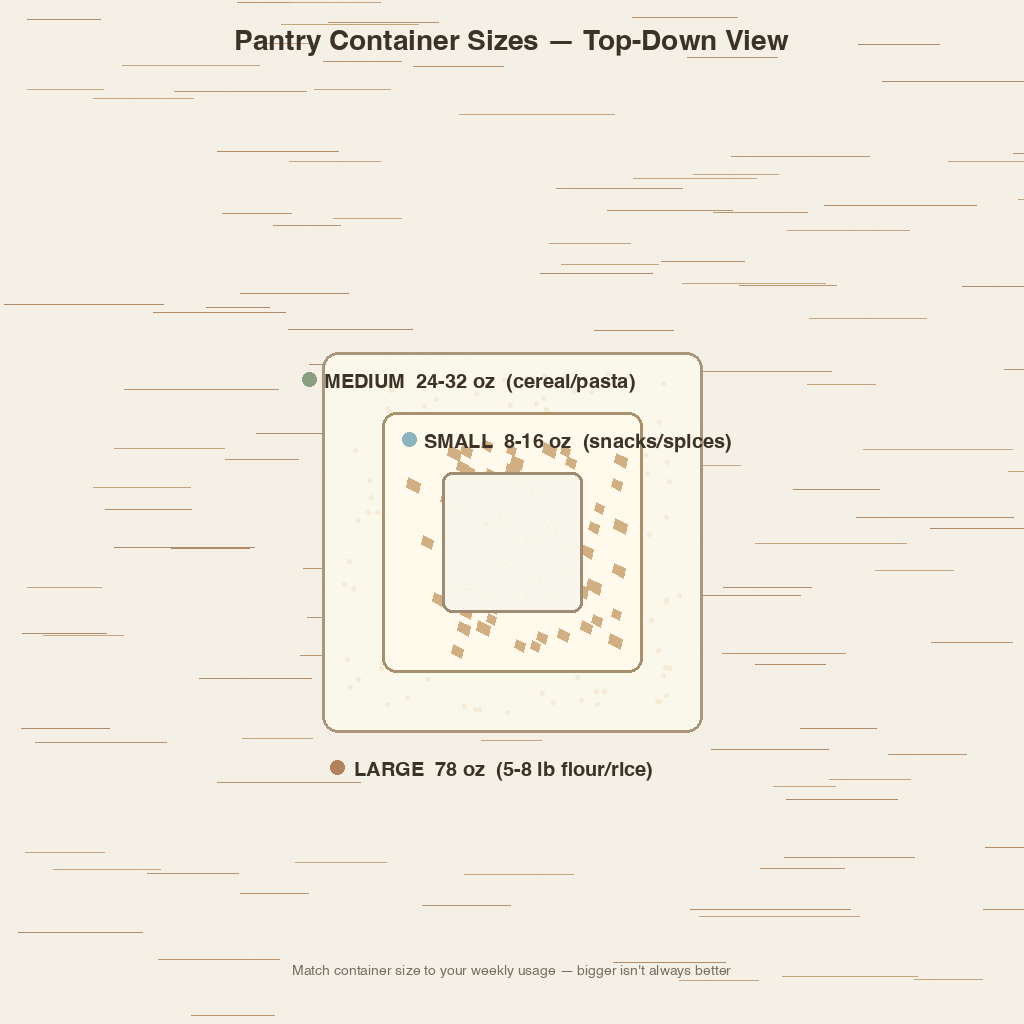
The workhorse size. Buy at least 6-8 of these. Square 64-oz is the sweet spot for a 1-lb bag of flour or 12-oz box of pasta. The CHEFSTORY 8-pc set ships with four sizes including medium (1.5QT) and large (1.8QT) that match these volumes. For pantry baking zones with deeper shelves, see pantry baking zone for shelf-clearance considerations.
Large (78oz-2L) — bulk rice, dog food, large cereal boxes
One or two 78oz square glass jars hold 5 lbs of flour or 8 lbs of rice. The Vtopmart 78oz Clamp-Lid 3-Pack handles 5-8 lb capacity per jar with a 4-sided metal clamp that holds seal for 12-18 months. If you decant big bags into big jars, plan for taller shelves (10-12” clearance). For Costco-scale bulk, see pantry bulk overflow for the 4-zone bulk-storage system.
Decanting Decisions: What to Decant (and What to Leave)
Decant — anything you reach for weekly
Flour, sugar, brown rice, white rice, pasta, cereal, oatmeal, coffee, nuts, dried fruit, snack bars, chocolate chips, pet treats. The PRAKI 24-pc set covers this whole category for $20, no need to over-buy sizes.
Don’t decant — keep in original packaging
Unopened backups (a second bag of flour behind the first), anything with a freshness date you want to read, cooking oils (light degrades them; dark bottles are fine), spices you’re using within 2 weeks.
The “one in, one out” rule
Every jar you buy should replace a partially-empty original bag in the trash. Net result: less visible clutter, less waste. Without this rule, we see clients end up with a pantry of full matching jars plus 8 half-empty original bags behind them. The pantry inventory method operating system pairs naturally with this rule.
Visual: decant vs don’t decant
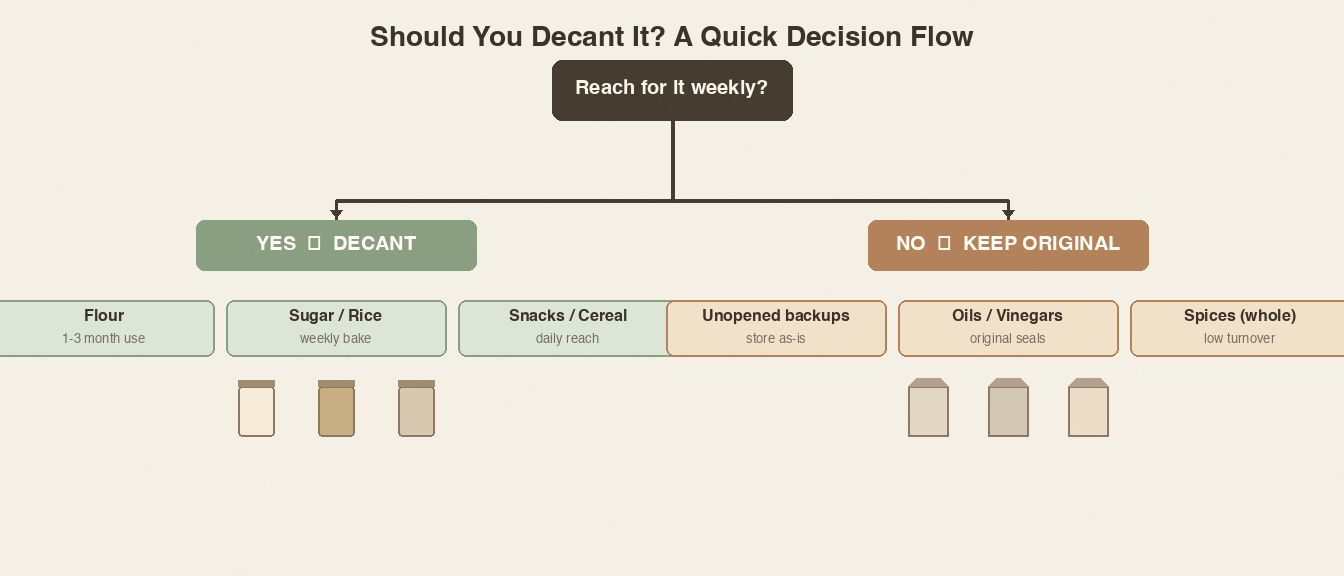
The flow above is the cheat sheet for every item you hold in your hand. When in doubt: if it’s open and used weekly, decant. If it’s sealed or rarely touched, leave it.
Airtight Mechanisms: Clamp vs Screw vs Snap-Lid
Clamp-lid (Fido-style) — best seal, most ceremony
Four-sided metal clamp with rubber gasket. Reliable 12-18 month seal if you clean gaskets monthly. Best for sugar, flour, anything hygroscopic. The Vtopmart 78oz Clamp-Lid Jars ship with this mechanism in a 3-pack.
Screw-top with silicone gasket — best balance
Most modern plastic sets (PRAKI, CHEFSTORY) use a snap-or-press lid with silicone ring. Quick to open one-handed, decent seal, gaskets replaceable.
Snap-lid only (no gasket) — fine for dry, bad for humid pantry
Cheap sets skip the silicone. Fine in climate-controlled kitchens; risky near a dishwasher, oven, or exterior wall.
Layout by Pantry Size (R11-7 Layer 1)
Small reach-in (1-2 shelves, 18-24” wide)
Pick one material (all glass OR all plastic, not mixed) and one height. Two sizes max: small (spices) + medium (staples). Skip large jars entirely. The CHEFSTORY 8-pc set covers a 2-shelf pantry on its own; add Chalkboard Labels to label everything. For small pantry organization on a 1-shelf pantry, scale down to one medium set and skip large jars entirely.
Medium reach-in (3-4 shelves, 24-36” wide)
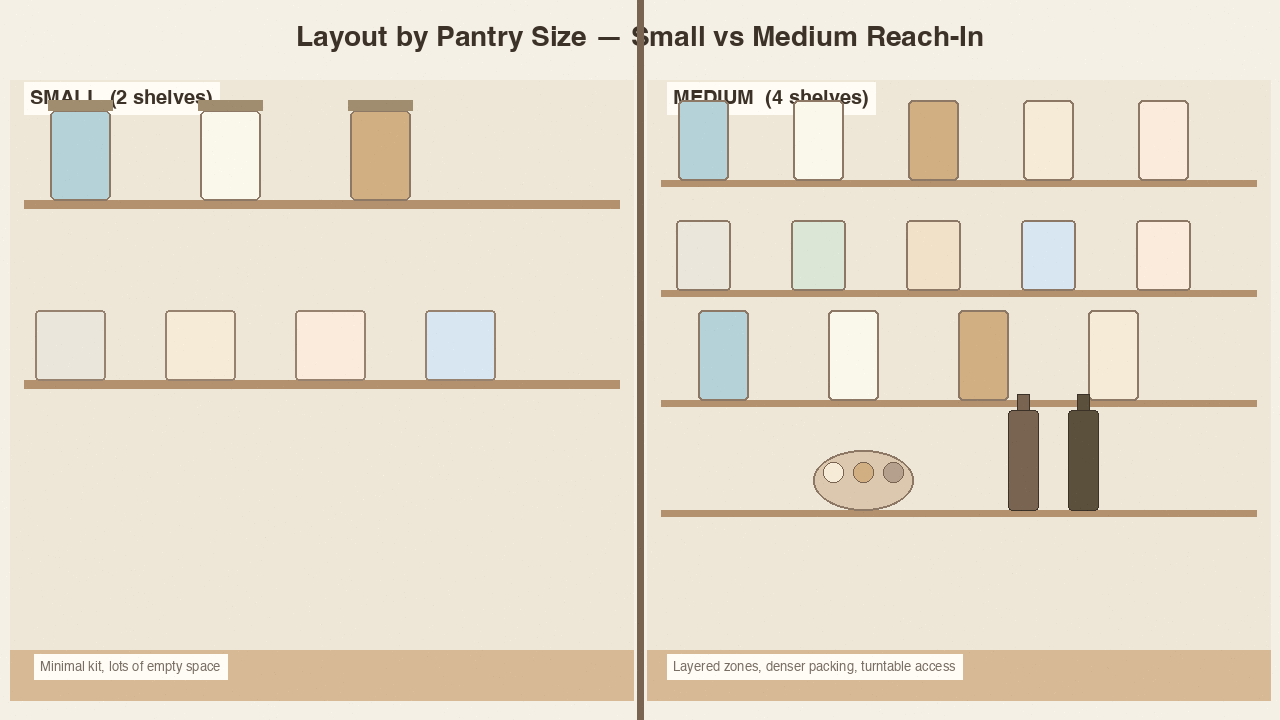
Layer by frequency: top shelf = rarely-used (baking supplies in Vtopmart Glass 7-Pack + ComSaf Tiered Glass); middle shelf = weekly staples (medium airtight set like CHEFSTORY); bottom shelf = bulk and heavy (large jars like ComSaf Square 78oz). Add the Lazy Susan 4-Pack on one shelf for vinegars, oils, syrups.
Large walk-in or pull-out pantry (5+ shelves)
Dedicate one full shelf to “decanting overflow” — bulk rice, dog food, large cereal boxes with Chalkboard Labels on the original packaging. Use the Lazy Susan in every corner. Glass + plastic mix is OK at this scale if you group by zone. For walk-in scale, see pantry storage solutions for the broader storage framework, and pantry zone system for the 5-zone organization method that pairs with container choice.
Constraint Guide by Scenario (R11-7 Layer 2)
If you’re renting and can’t drill or paint shelves
Stick with modular containers that fit existing shelf dimensions. Square 64-oz stacks in any pantry. Skip magnetic or mounted solutions. CHEFSTORY 8-pc + Chalkboard Labels are renter-safe. For opaque bin alternatives, see storage bin selection guide.
If you have a small budget ($30-50)
Buy one 24-pc plastic set like PRAKI + one Chalkboard Labels pack. Skip glass entirely for now. Glass costs 3-5x plastic per cubic inch and offers diminishing returns until you have ~10 staples decanted.
If your pantry is in a humid climate or near the dishwasher
Choose plastic with silicone gasket like CHEFSTORY or PRAKI over glass with clamp lid. Glass + humidity = condensation on the gasket, which shortens seal life. Or run a small dehumidifier and we recommend that for any climate-controlled pantry near heat sources.
If you buy in bulk (Costco / Sam’s Club)
You need at least one large jar per bulk item — typically 4-6 large jars total. Vtopmart 78oz Clamp-Lid or ComSaf Square 78oz at 78oz holds a 5-lb bag of flour. Don’t try to decant Costco bags into 32-oz jars; you’ll have 6 jars per bulk item and no shelf space left. For the broader bulk system, see pantry bulk overflow.
If you want visual calm (KonMari, minimal aesthetic)
Use opaque bins (canvas basket / fabric bin class — see storage bin selection guide) for everything except flour/sugar/rice. The trade-off: you lose the inventory signal. Pair the visual calm with a small inventory list, or use the Chalkboard Labels on the front of each opaque bin to keep the inventory signal. Add a Lazy Susan 4-Pack inside deep corners so the back row stays reachable without breaking the calm. For the philosophy, see KonMari method.
Labeling That Actually Helps
Chalkboard labels + chalk marker
Reusable, repositionable, $8-12 for 180-200 labels. Works on glass, plastic, and metal. The 200 Chalkboard Labels pack ships with a fine-tip marker — fat chalk looks like a kindergarten project. For deeper labeling guidance, see how to label anything.
Pre-printed label maker (Brother / DYMO)
More polished, more expensive ($30-50 device + $10-20 tape). Tapes yellow over time. Better for permanent labels than repurpose-friendly ones.
What to put on the label
Item name + best-by date of the original packaging. Skip the date you decanted (you’ll forget). For bulk bins, add a “refill from” location pointer so you remember where the backup lives.
Common Mistakes
Buying 30 containers in 5 different shapes
You’ll have 4 lids with no jars, 3 jars with no lids, and an aesthetic mess. We’ve watched this mistake play out in dozens of pantries — the urge to mix is strong, and the cost adds up. Stick with one set for 80% of the pantry; only add a second material if you have a specific need (e.g., glass for flour because you bake weekly). For the broader storage framework, see pantry storage solutions.
Decanting before measuring your shelves
Container sets have a “standard” height (8-12”) that won’t fit in shallow cabinets (6”). Measure three shelves before ordering. See pantry baking zone for shelf-clearance considerations at different shelf depths.
Skipping the gasket-clean routine
Silicone gaskets collect flour, sugar, oil. Once a month, pull the gasket out, wash with warm soapy water, dry fully, re-seat. We mark a calendar reminder because our own gaskets go 8 months before we notice. Skip this and your “airtight” container leaks air in 6-9 months.
Ignoring the weight
A 78oz glass jar full of flour weighs 8-9 lbs. Three of those on a single shelf = 25-30 lbs. Wire-frame shelves (typical builder-grade pantry) hold that fine; some laminate shelves bow at 20+ lbs.
Decanting spices
Spices lose volatile oils within weeks of opening. A $5 spice rack with original bottles visible is more functional than 12 matching jars of stale cumin. See spice organization for the exception.
What to Buy Only If Needed
Lazy susan only if your pantry depth exceeds 14”
Shallow reach-ins (12” or less) waste 50% of the back shelf on a turntable. Skip it. Deep walk-ins benefit hugely. Lazy Susan 4-Pack at $18 covers most pantry configurations.
Opaque bins only if you have 15+ decanted items
Fewer than 15 visible jars = the “matching plastic” aesthetic reads as curated. More than 15 = visual chaos. Opaque bins reset the visual. For the visibility trade-off, see clear bins vs opaque bins.
Label maker only if you bake or cook from written recipes weekly
Otherwise chalkboard labels + marker are enough.
Related Guides
Start with the pantry organization hub for the full room system, then use these focused guides:
- Pantry zone setup method — 5-step zone assignment for the daily-use shelves.
- Pantry inventory method — FIFO rotation + restock cadence.
- Pantry storage solutions — bin, jar, and rack pick by shelf depth.
- Pantry bulk overflow — Costco-run overflow framework for households that buy in bulk.
- Small pantry organization — 1-shelf reach-in pantry scale-down for the container set.