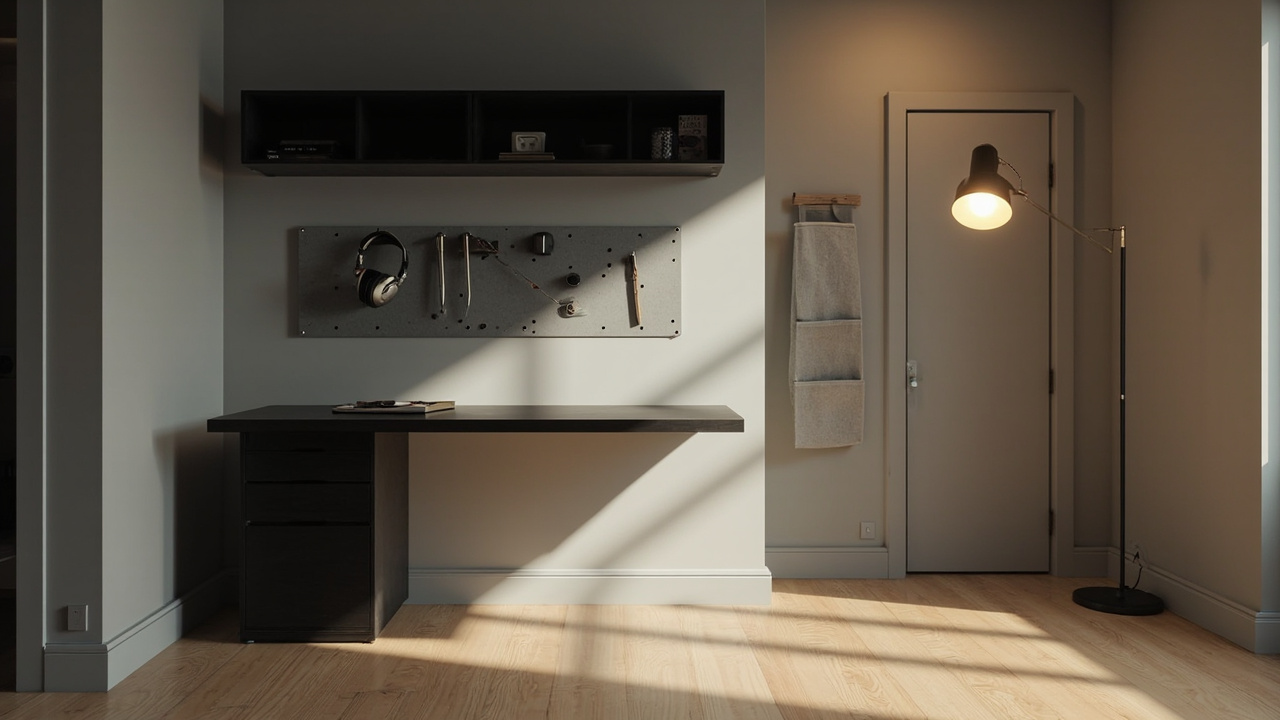
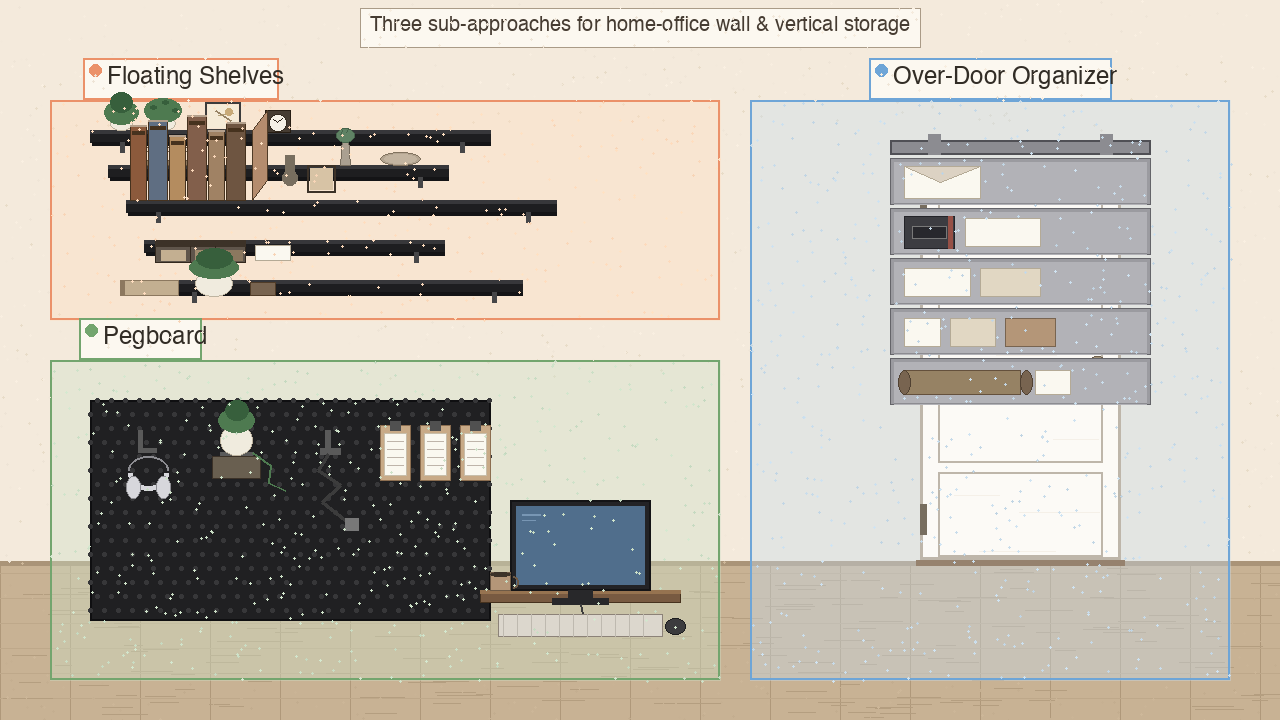
A home office runs out of two surfaces at the same time: desk and floor. Once both are spoken for, the next-best place to add capacity is straight up. Walls stay out of the chair path and convert cubic feet inside your four walls into usable storage for binders, headphones, mail, plants, and active project folders. The trick is matching the sub-approach to your wall’s anatomy. Three sub-approaches — floating shelves, pegboards, and over-the-door organizers — cover almost every home office layout. Pick two based on what your wall can hold and what your door can carry.
This guide sits inside the home office organization hub and the home-office 5-zone system. Desk-side zones live on the home office desk organization guide; cable routing lives on home office cable management. Wall space converts cubic feet inside the room into usable storage without buying a square inch of floor.
Why Home Office Walls Pay Back the Most Storage Per Square Foot
Every home office hits the same wall — literally — at the same time. The desk surface fills with current work. The floor fills with cables, a bin, and a chair-arc. The next surface that adds cubic capacity without stealing square footage is the wall. A 64-inch wall run above a desk can hold three floating shelves plus a small pegboard strip; that wall run costs zero square feet and never blocks a chair path.
The wall-vertical approach beats three alternatives for tight rooms. It beats under-desk storage, which sits in the chair-arc and limits legroom. It beats rolling cabinets, which steal floor space and add a trip hazard. It beats closet conversion, which requires tearing out a closet rod. Walls are already there, inside your four walls, waiting to be used.
The catch is wall anatomy. Hollow drywall can take 15 lb with plastic anchors and 50+ lb into a stud. Concrete or brick wants masonry screws. Rentals want damage-free adhesives or over-the-door gear that leaves zero trace. Pick the wrong anchor and the cheapest shelf becomes a $200 spackle lesson; pick the right one and the same shelf carries books, plants, and a monitor for a decade.
What You’ll Need: 7 Picks Mapped to 3 Approaches
The 7 picks below cover three sub-approaches — pegboards, floating shelves, and over-the-door organizers. Prices verified via Amazon Creators API on August 8, 2026. The split is 3 pegboards, 2 shelves, 2 over-door.
Pegboard — rental-friendly: Keepo modular plastic pegboard ($38.99)
The Keepo Peg Board Wall Organizer at $38.99 is the renter’s entry. Modular plastic panels snap together without tools, light enough for adhesive mounting.
Pegboard — heavy: WallPeg 4-panel metal kit ($79.99)
The WallPeg Pegboard Kit at $79.99 anchors into studs and accepts standard 1/4-inch hooks. Four 24”x16” panels make a 64”x24” grid.
Pegboard — modular: Wall Control Horizontal metal pack ($69.99)
The Wall Control Horizontal metal pack at $69.99 is the modular expansion — horizontal panels that mount side-by-side into studs.
Shelf — modern: upsimples floating shelf set ($25.99)
The upsimples Floating Shelves at $25.99 covers six matte-black shelves, each rated to ~22 lb stud-mounted.
Shelf — farmhouse: WOPITUES wood floating shelf set ($29.99)
The WOPITUES Wood Floating Shelves at $29.99 covers six shelves in warm wood, anchors cleanly into studs.
Over-door — paper: homyfort over-the-door file organizer ($13.99)
The homyfort Over the Door File Organizer at $13.99 drapes over a standard interior door and carries five pockets of mail and project folders.
Over-door — shelves: JARLINK 5-shelf over-the-door ($19.98)
The JARLINK Over the Door Organizer at $19.98 is the rigid version with an anti-tilt bracket for up to 45 lb.
The 3-Approach Wall System
Three sub-approaches cover most home offices. Pick two based on what your wall can hold and what your door can carry — you don’t need all three.
Approach 1: Floating Shelves
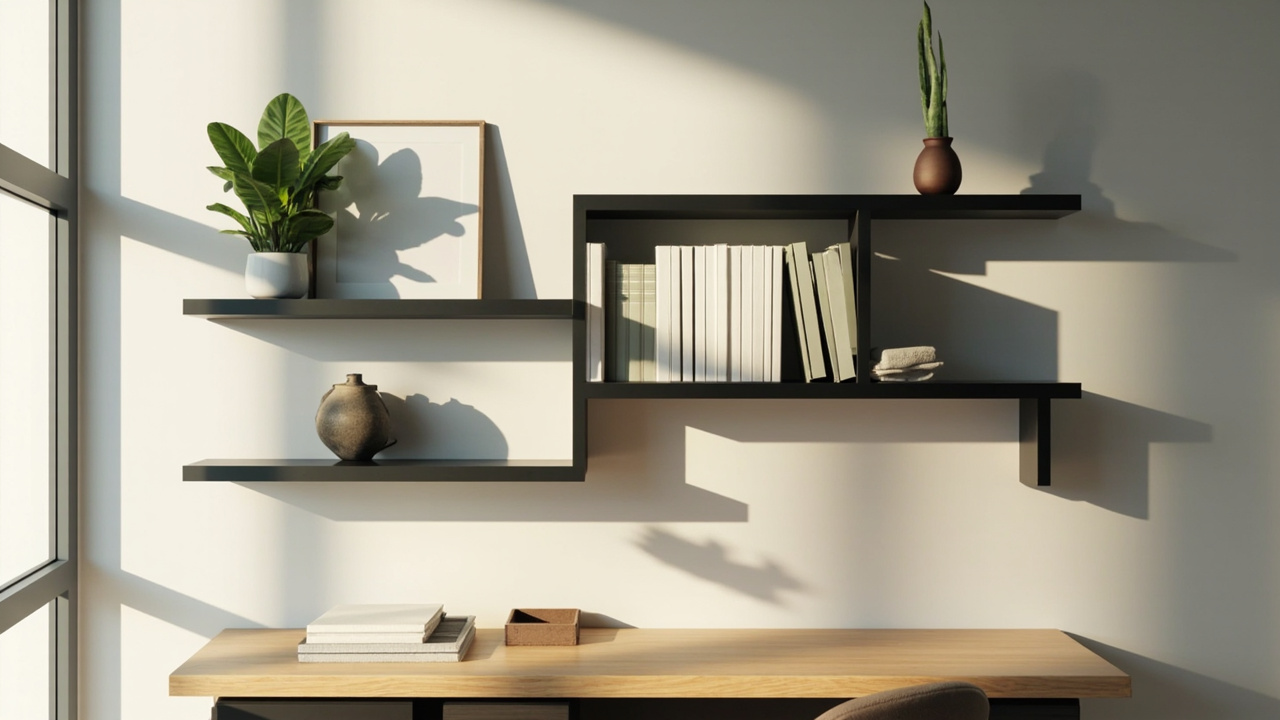
Floating shelves do the heavy-lifting aesthetic work. They frame the desk, hold books and plants, and replace a floor bookcase. Trade-off: most floating shelves want studs (every 16 inches), and a missed-stud anchor rated for 15 lb will not save your monitor when it slips.
The upsimples floating shelf set ($25.99) covers six shelves and the WOPITUES wood shelf set ($29.99) covers the same six in warm wood. Both ship with anchors rated for ~22 lb per shelf stud-mounted. For damage-free hooks below the shelf, see the hooks and racks for vertical storage guide.
Shelves pair naturally with bins for binders. The how to choose storage bins guide covers fit rules — clear stackable bins inside floating shelves are the highest-density paper-workflow anchor under $50.
Approach 2: Pegboard Walls
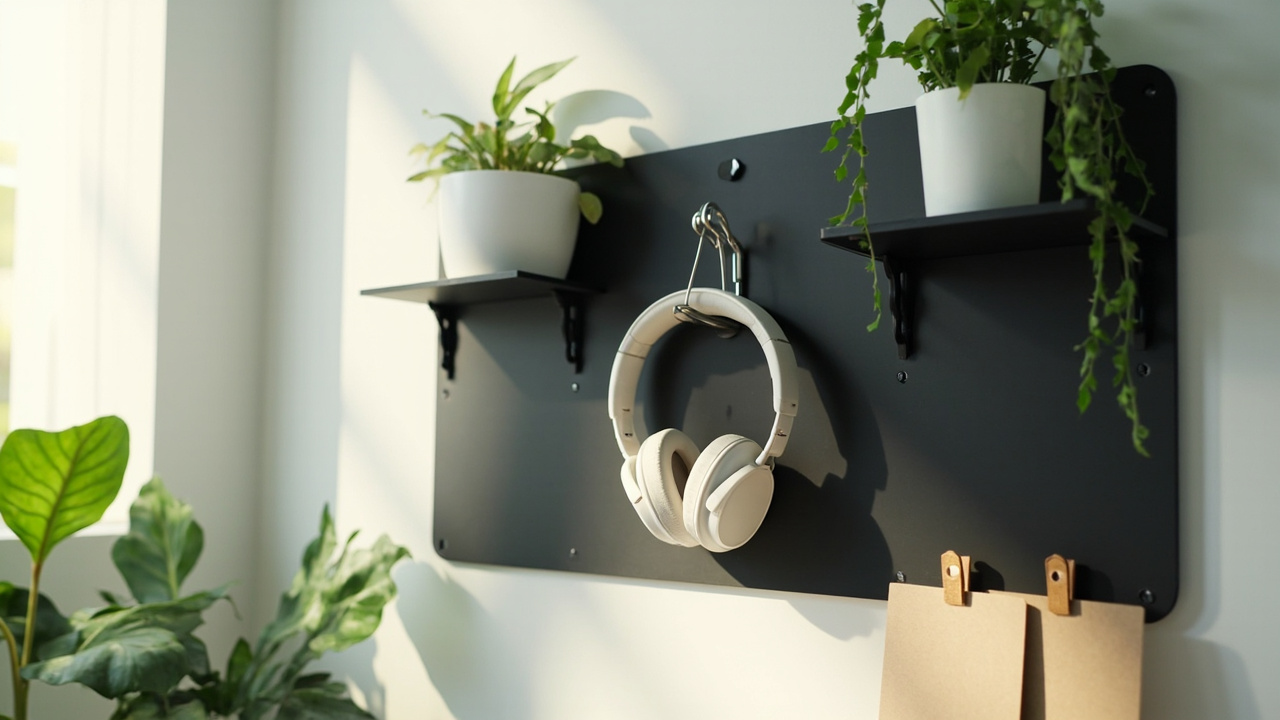
Pegboards earn their keep when you re-arrange weekly — craft tools, headphones, monitors on arms, charging cables, plants. Pegboards are the only wall storage that re-configures in seconds without re-drilling.
For renters, the Keepo modular plastic pegboard ($38.99) snaps together without tools. For serious load-out, the WallPeg 4-panel metal kit ($79.99) anchors into studs. The Wall Control Horizontal metal pack ($69.99) is the modular expansion.
Pegboard doesn’t replace filing. Active paper belongs on the home office paperwork system or in the home office paper filing rhythm.
Approach 3: Over-the-Door Organizers
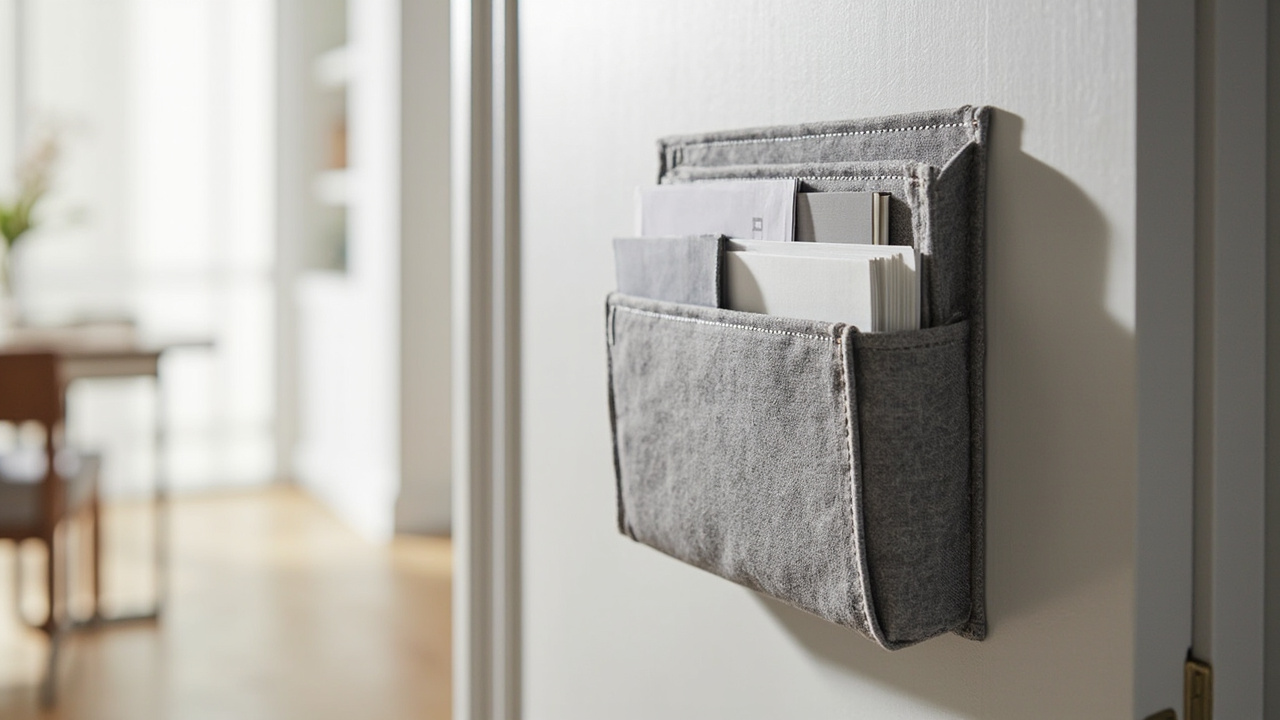
Over-the-door gear is the no-drill rental anchor. Two styles: the soft-pocket file folder for paper, and the rigid shelf rack for everything else. Both assume a standard 1.75-inch interior door.
The homyfort over-the-door file organizer ($13.99) drapes over the door and carries five pockets of mail and folders. The JARLINK 5-shelf over-the-door ($19.98) is the rigid version with an anti-tilt bracket for up to 45 lb.
When the office shares the bedroom, the small home office storage guide covers how to share the door with a closet rod without blocking door swing.
Layout by Office Size
Wall zones scale with the room. Three bands cover almost every home-office footprint.
Small (<50 sq ft)
Walls are at a premium, and the chair path is the constraint. Run a single floating-shelf row above the monitor plus one pegboard strip next to the desk. Skip the over-the-door organizer if the door opens against a wall — it’ll block swing. The Keepo plastic pegboard ($38.99) and the upsimples floating shelves ($25.99) are the budget pick here.
Medium (50-100 sq ft)
This is the most common band. Two walls are usable: one above the desk, one beside it. Run the WOPITUES wood shelves ($29.99) above the monitor and the WallPeg metal kit ($79.99) on the side wall. Add the homyfort over-the-door file organizer ($13.99) on the door if active paper is overflowing the desk.
Large (>100 sq ft)
A spare room or dedicated office usually has a wall or two that runs longer than 100 inches. Run a six-shelf upsimples gallery ($25.99) plus a pair of Wall Control horizontal panels ($69.99 each) side-by-side. Skip the over-the-door organizer — the room has wall space for active paper.
Constraint Guide by Scenario
Six scenarios cover the highest-frequency room-and-wall combinations. Pick the scenario that matches your home office.
Renting (no drilling, no painting)
The constraint is no spackle at move-out. Skip floating shelves unless your lease allows picture nails. Run the Keepo plastic pegboard ($38.99) with adhesive mounting strips rated for the panel weight. Pair with the homyfort over-the-door file organizer ($13.99) for paper. Total: $52.98, zero holes.
Budget under $50
Run the upsimples floating shelves ($25.99) at stud-spaced anchors plus the homyfort over-the-door file organizer ($13.99) for paper. Total: $39.98.
Heavy load (monitors, camera bodies, studio gear)
Run the WallPeg metal kit ($79.99) anchored into studs. Skip floating shelves — pegboard handles monitor arms and camera bodies more cleanly than a 22-lb-rated shelf. Pair with the WOPITUES wood shelves ($29.99) for books above the monitor. Total: $109.98.
No closet at all
Run a single WOPITUES wood shelf row ($29.99) for the things that would normally go in a closet — coats, scarves, the day’s backpack. Pair with the JARLINK 5-shelf over-the-door ($19.98) for shoes.
Concrete or brick wall
Skip plastic anchors — they don’t bite into masonry. Run masonry screws (Tapcon 3/16”x1-3/4”, $8 for a pack) into the upsimples shelves ($25.99) or WOPITUES shelves ($29.99). Concrete walls carry 75+ lb per shelf with the right anchor.
Re-arranging weekly (rotating project tools)
Pegboard is the only answer. The Wall Control Horizontal metal pack ($69.99) accepts standard 1/4-inch hooks that move without tools. Pair with the Keepo plastic pegboard ($38.99) for the second wall. Total: $107.98.
How to Mount Without Wrecking the Wall
Five steps cover every floating-shelf and pegboard install. Skip a step and the shelf fails within months.
Step 1 — Find the studs
A stud finder locates the 2x4 framing behind drywall. Studs sit 16 inches apart in most homes.
Step 2 — Pre-drill pilot holes
Use a drill bit slightly smaller than the screw shank (1/8 inch for #8 screws). Pilot holes prevent drywall cracking when the screw goes in.
Step 3 — Drive anchors or screws
For floating shelves, drive the lag screw until the bracket sits flush. For pegboards, drill into the stud and mount with two screws per panel minimum.
Step 4 — Level + shim if needed
Set a 4-foot level across the top edge. If the bracket sits off, shim with a folded piece of cardboard before tightening.
Step 5 — Load test before trusting
Load the shelf with twice the rated weight for 60 seconds. If anything shifts, pull it out and re-mount. The upsimples shelves and WOPITUES shelves ship with anchors; WallPeg and Wall Control need separate hardware.
Common Mistakes
Five mistakes show up in failed wall-storage photos.
Mistake 1: Mounting shelves into drywall without anchors
Even light books on a drywall-only shelf will pull the screw out within months. Every floating shelf needs a stud, toggle bolt, or rated drywall anchor — the upsimples shelf set ships with anchors, use them.
Mistake 2: Buying pegboard before measuring wall space
A single 24x48 inch pegboard covers a small wall; a 4-pack covers a corner. Measure first, then order — the WallPeg kit covers 64x24 inches, the standard home-office size.
Mistake 3: Over-the-door organizers blocking door swing
A 5-shelf JARLINK adds about 5 inches of door depth. Doors that open against a wall or into a narrow hallway will hit the organizer — measure door-swing arc first.
Mistake 4: Mixing aesthetic styles on one wall
A black metal pegboard next to a farmhouse wood shelf next to a grey fabric door organizer reads as three different offices. Pick a finish family — modern matte black, warm wood, or industrial metal — and stick with it. The upsimples black set and the Keepo plastic pegboard are both black for a unified look.
Mistake 5: Loading floating shelves above rated weight
The upsimples shelf is rated 22 lb per shelf when stud-mounted. Three ring binders plus paper is about 12 lb. Add plants or a monitor and you cross the rating — distribute weight across shelves and never load one past its limit.
Quarterly Wall Reset
Walls accumulate dust and seasonal leftovers faster than the desk does. A four-step reset every three months keeps the system honest:
- Audit weight — pull every item off every shelf and hook. Anything not touched in 90 days goes into a keep / donate / relocate pile.
- Dust and inspect — wipe every shelf surface, vacuum pegboard holes with a brush attachment. Check that no anchor has slipped out of the wall.
- Re-anchor if needed — a shelf that wiggles under load is about to fail. Tighten or re-mount before trusting it.
- Swap seasonal items — heavy winter coats come off the door organizer in spring; plants move outdoors. The small space decluttering guide covers the same calendar logic for tight rooms.
Related Guides
- Home office organization hub — full home-office system map.
- Home office desk organization — desk-side declutter that pairs with wall zones.
- Small home office storage — companion piece covering under-desk + closet systems for tight rooms.
- Home office cable management — wall channel routing for cables running up to wall-mounted shelves.
- How to choose shelf organizers — fit rules for under-shelf baskets.
- Hooks and racks for vertical storage — weight-limit guide for damage-free hooks.
- How to choose storage bins — clear stackable bins inside floating shelves.