Laundry supplies stay organized when each product form (liquid, pods, powder, softener, bleach, scent beads, stain treatments) gets a matched container, a measured shelf, and a fixed rotation cadence. The fix: a five-form audit, one shelf + one drawer + one caddy per zone, and a dedicated stain station you can grab in under three seconds.
This page covers the method. The sister laundry supplies organization guide covers the product-zone map. For the broader workflow, see the laundry room organization hub and the laundry hub.
Quick Answer
A working laundry supply storage has three containers per product form (decant jar, latching pod jar, drip-catcher cup), one 18-inch wire shelf, one subdivided drawer, and one small caddy for the stain-treatment pens. Measure jug height and gap width before you buy; lock pods and bleach behind child-safety latches; rotate stock every 90 days.
Why Laundry Supplies Sprawl
Most households run pods and liquid and softener and a stain spray and scent beads. Three failure modes show up in week one:
- Cabinet-depth mismatch. Warehouse jugs sit too tall for the standard 12-inch shelf above front-load washers.
- Open baskets fail child safety on day one. Toddlers reach low open shelves.
- Pretty-jar decanting of bleach. Glass jars corrode after a month of bleach.
A declutter fast sweep first. The audit below measures what survives.
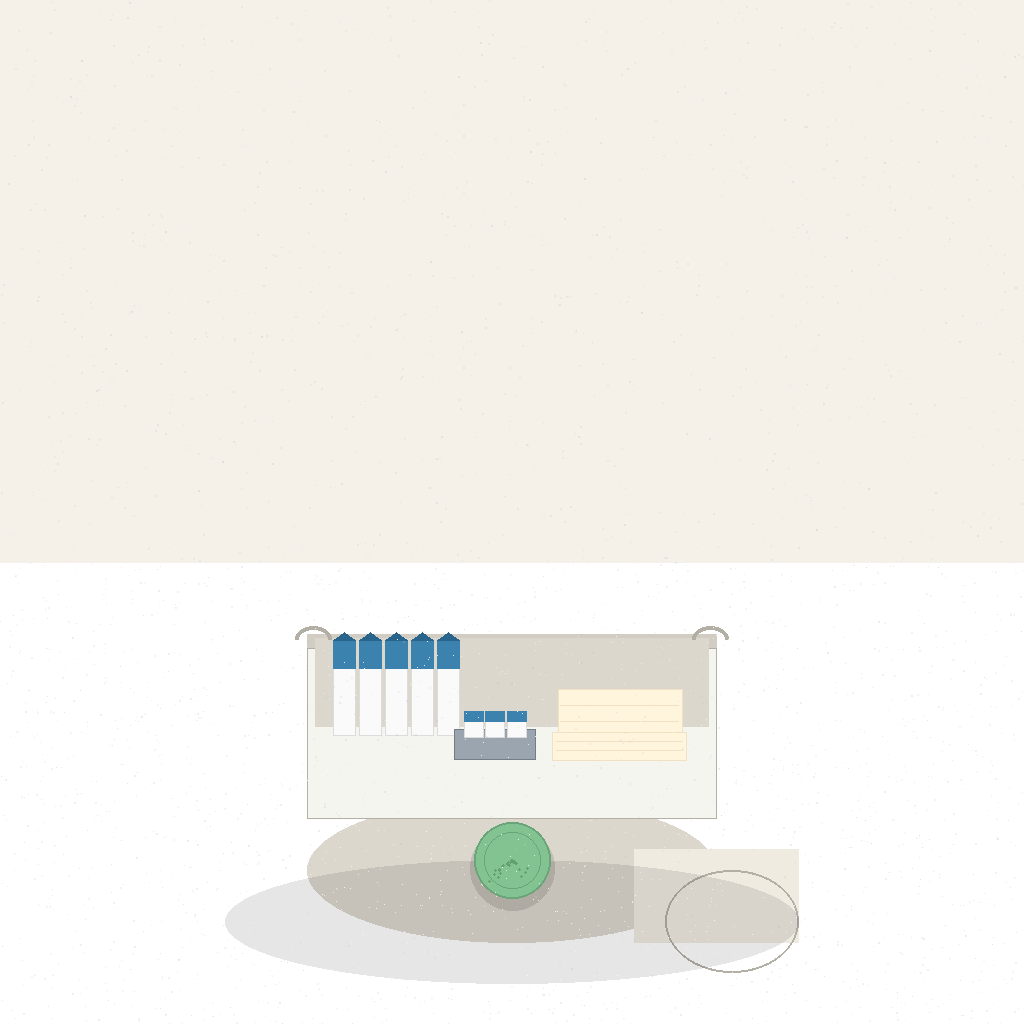
What You’ll Need: 8 Supply Systems That Earn Their Spot
You don’t need eight gadgets on day one. Five systems cover pods, powder, slim gaps, no-drill walls, and locks — and the caddy sits on the dryer top so a pen is always within reach.
Stain-treatment caddy (the dedicated zone)
A small open caddy on the dryer top, holding Tide stain remover spray 2-pack, a Tide 3-pen backup, and a microfiber cloth. The caddy sits where you sort — the point is 3-second access.
Pods and powder jars
A Lifewit 3-pack pop-up pods container holds pods, scent beads, and a spare. Pop-up lidded jars beat screw-on for daily use but stay child-resistant between loads. For >5 lb bulk powder bags, decant into ComSaf 3-pack 78-oz airtight glass jars — wide mouth for a measuring scoop, airtight clamp blocks humidity.
Workhorse supply bins
A SKTEET 8-pack clear stackable bins holds softener, scent booster, washing soda, dryer balls, cloths, and an overflow slot. Clear body lets you audit without lifting the lid. For back-stock, IRIS USA 4-pack 13-quart bins cover Costco refills, paper towels, and dryer ball replacements.
Drawer organizers
The laundry-room drawer needs cells, not piles. A WOWBOX 25-piece drawer organizer set subdivides cells for stain pens, sewing kit, lost-sock orphanage, mesh bag stash, and dryer balls. 14K-review base means dimensions match marketing.
Wall-mounted wire shelf
A ClosetMaid SuperSlide 4-foot ventilated shelf is the wall backbone (drywall anchors included). Wire grid circulates air so bottles don’t sweat; pairs with the SKTEET bins above as the supply-shelf structure.
For bin materials and lid styles, see how to choose storage bins. For drawer materials, how to choose drawer organizers.
Step 1: Run the 5-Form Audit
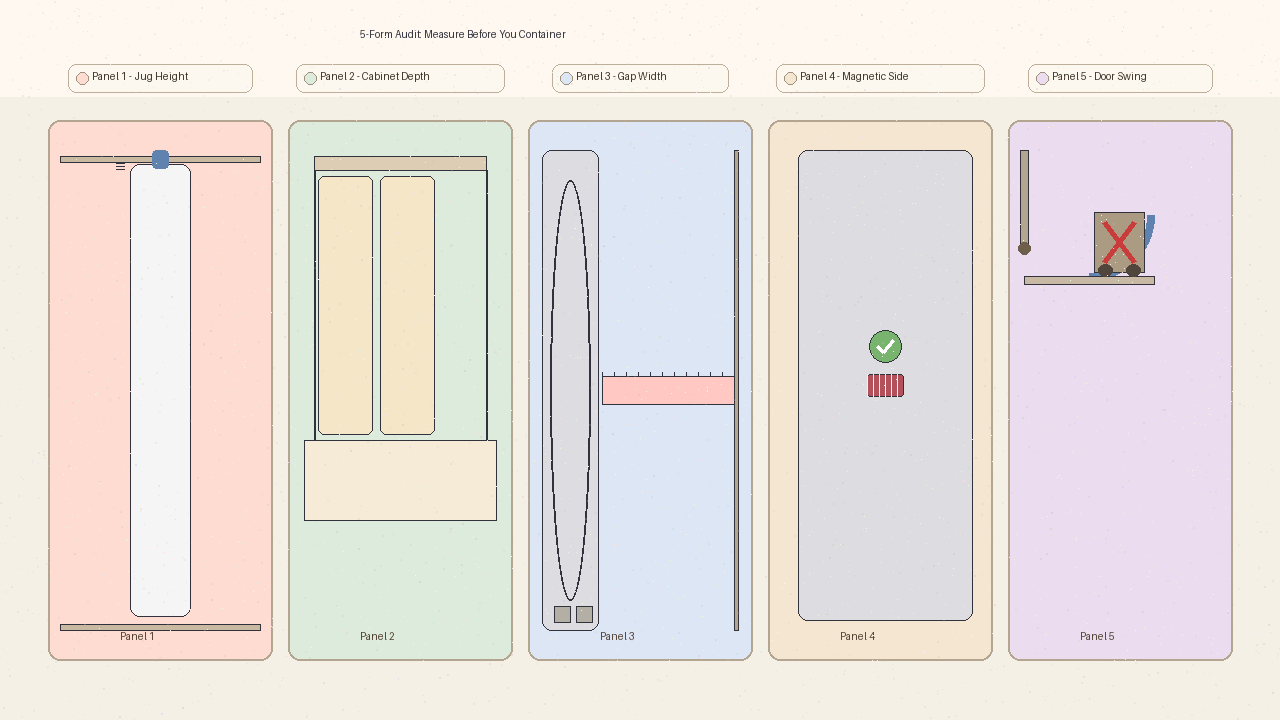
Before any container, fill in five numbers. Supply zones collapse when this audit is skipped, so the five measurements come first every time.
- Jug height — tallest bottle including cap. Front-load-washer shelf clearance is usually 12 inches; if the jug is 13 inches, you have a bottle problem, not a shelf problem.
- Cabinet depth — inside, not outside. Standard upper cabinets are 12 inches deep; many laundry shelves above front-loaders are 9-10 inches.
- Gap width — tape between washer and wall. Under 6 inches = slim cart; 6-10 inches = 2-tier rolling; 10+ inches = full over-washer shelf.
- Magnetic side panel — try a fridge magnet on the washer side. If it sticks, magnetic shelves work; if not, tension-rod problem.
- Door swing — measure the radius from the hinge. A 4-tier rolling cart in front of the door kills the entire room.
Tape that sheet to the inside of the cabinet door. When a container fails the audit, return it within the window.
Five measurement labels at a glance
Step 2: Build the Dedicated Stain Zone
The stain zone is the part of the layout you reach for first. If you can’t grab a stain pen in three seconds from the sorting surface, you don’t have a stain zone — you have a pen in a junk drawer.
Why a dedicated zone beats stashing pens everywhere
Households that keep pens in the kitchen, car, laundry junk drawer, and master-closet drawer lose all four within six months. One dedicated caddy keeps pens where you sort, which is where stains happen.
Where to put the caddy
Three positions, in order of preference:
- On top of the dryer — heat-safe caddy only. The caddy hits the visual cue each time the dryer opens.
- On a magnetic shelf on the washer side — magnetic side panel required.
- In the top drawer of the laundry cabinet — reachable but we lose the visual cue.
Skip the bathroom. Stains happen at the table, couch, or wherever we sort clothes.
What goes in the caddy
- Two Tide stain remover spray 2-packs — one in use, one backup
- One Tide To Go pen 3-pack for purse or car
- Two microfiber cloths (washed weekly)
- One SOS pad per quarter
The caddy is for first-aid-for-clothes only. Backup detergent lives on the wire shelf.
Step 3: Stage Pods and Powder on the Wire Shelf
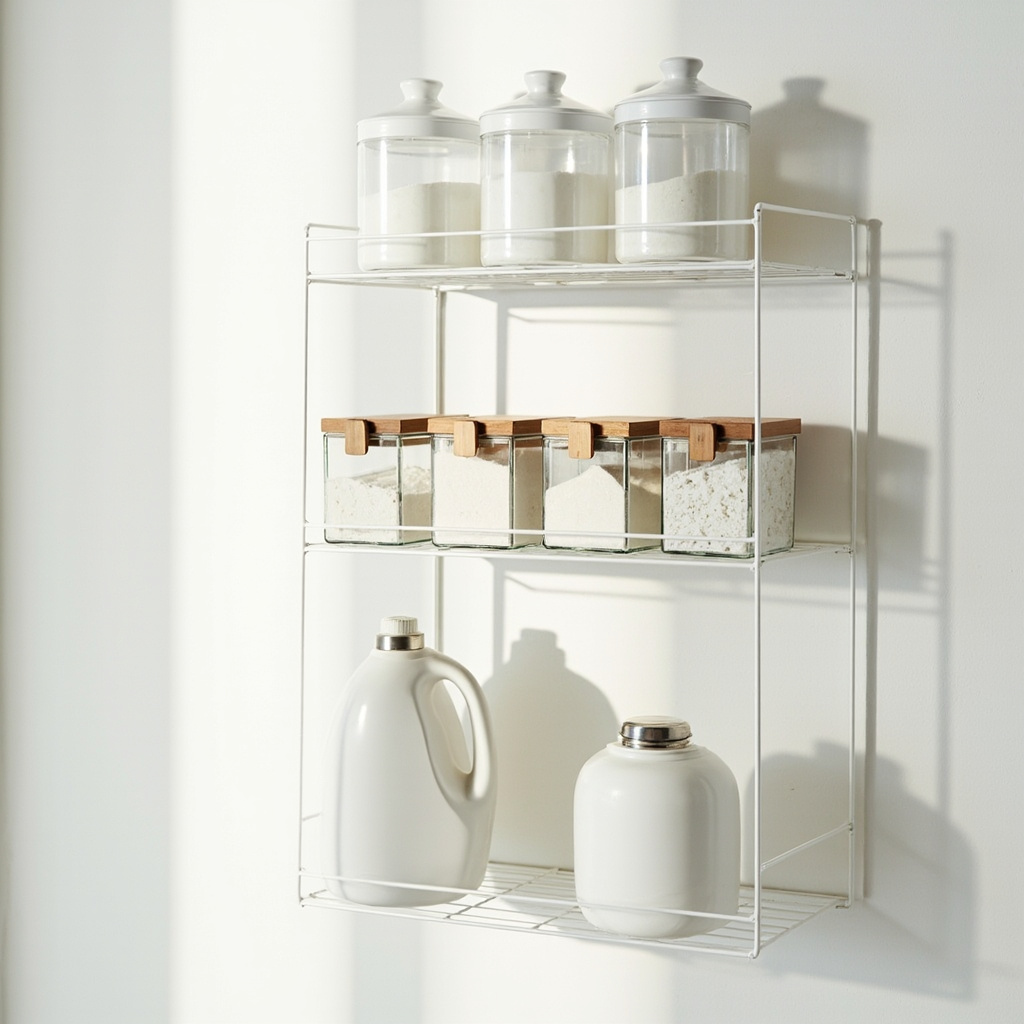
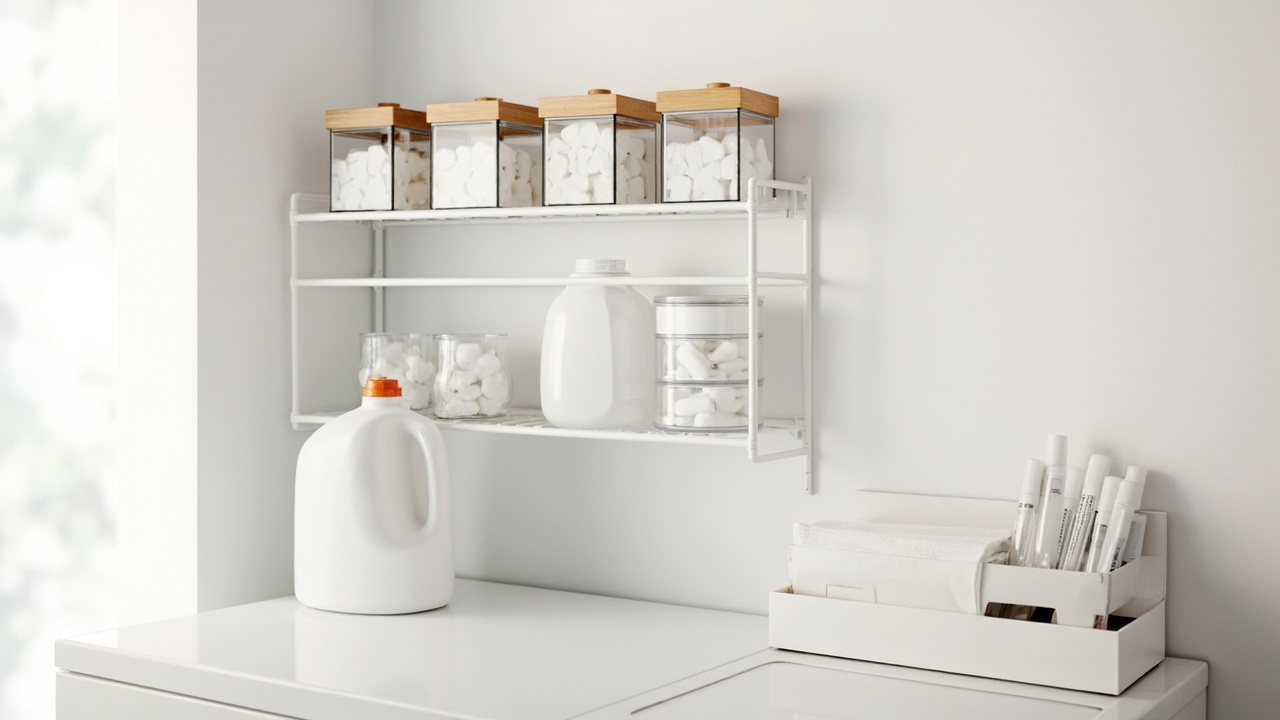
The wire shelf is the visual cue. When the supply zone drifts toward messy, the wire shelf is the first place to check.
Tier 1 (top) — pods and scent beads
Top tier holds the Lifewit pods container plus a scent-bead jar. Pop-up lid means you grab one pod without unscrewing. Top tier keeps pods above toddler reach.
Tier 2 (middle) — bulk powder
ComSaf 78-oz glass jars sit at adult eye level for measuring. Wide mouth takes a dry-measure scoop; airtight clamp blocks humidity.
Tier 3 (bottom) — liquids, softener, backup
Bottom tier carries the heaviest items: liquid detergent, softener, Costco refill. IRIS USA 13-quart bins under the shelf catch overflow.
Bleach lives separately
Bleach never sits next to ammonia cleaners. Keep it in its original bottle in a separate low closed cabinet.
Step 4: Subdivide the Laundry Drawer
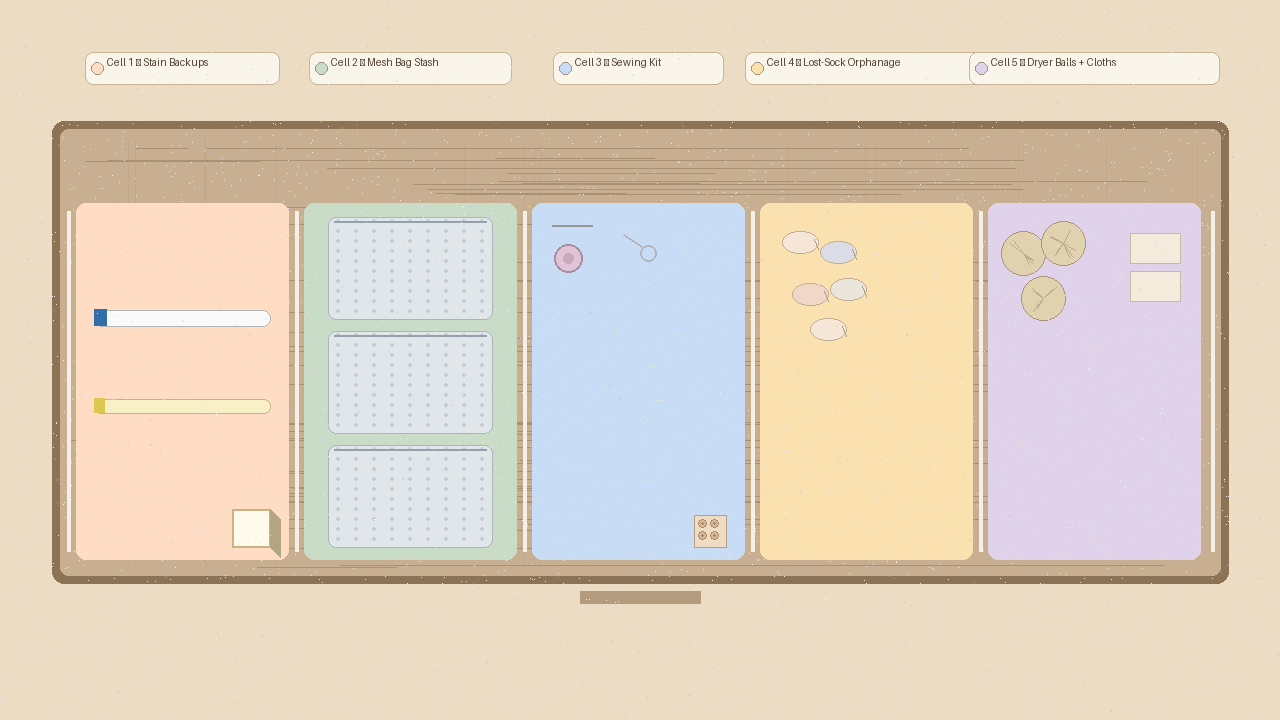
The laundry drawer (or any nearby utility cabinet drawer) needs cells, not piles. Without cells, sewing kit + lost-sock orphanage + dryer balls collapse into a single junk layer by week three.
Five cells, one drawer
A WOWBOX 25-piece drawer organizer set subdivides any standard drawer into 5 cells:
- Cell 1 — Stain treatment backups. Pen + bleach pen + baking soda.
- Cell 2 — Mesh wash bag stash. 3 mesh bags folded flat.
- Cell 3 — Sewing kit. Needles, thread spools, safety pins, button box.
- Cell 4 — Lost-sock orphanage. 4-5 socks loose until they find a match.
- Cell 5 — Dryer balls + cloths. 3 wool balls + 2 microfiber cloths.
Why cells survive a year and piles die in a month
A 25-piece set fits standard 16-inch-deep drawers. Smaller sets (4-piece, 6-piece) leave gaps where junk accumulates.
Step 5: Lock the 90-Day Cabinet Cycle
A supply zone that survives a year runs on a fixed rotation. Three cadences cover everything.
Monthly — pen + cloth swap
Pull the caddy. Toss pens that have dried out — a Tide pen won’t last 30 days once opened. Wipe the cloth bin and refill.
Quarterly — wire shelf reset
Pull everything off the ClosetMaid SuperSlide. Discard expired detergent (yes, it expires — check the bottle for the date stamp). Wipe the wire grid with a damp cloth. Refill the Lifewit pods jar and the ComSaf glass jars. This is the rhythm — every 90 days, no exceptions.
Annually — bin replacement
Replace the SKTEET stackable bins every 12-18 months. Plastic fatigues; lids start cracking past 24 months.
For the broader framework, see the declutter maintenance routine.
Layout by Storage Form (Layer 1)
Five storage forms cover every laundry layout. Pick the form your room already has, then build out the supporting pieces.
Stain-only caddy (dryer-top, <2 sq ft)
A small open caddy on the dryer top, holding Tide stain spray + Tide pen 3-pack + 2 microfiber cloths. Use this when you only have dryer-top real estate and no shelf. Pairs with the WOWBOX drawer set for drawer cell space.
Pods + powder jars (top-shelf, 2-3 sq ft)
Lifewit pods jar + ComSaf glass jars sit on the top shelf of the wire rack. Use this form when you have a wire shelf with at least 12 inches of vertical clearance.
Workhorse supply bins (mid-shelf, 4-6 sq ft)
SKTEET 8-pack stackable + IRIS USA bulk bins cover softener, scent booster, washing soda, dryer balls, cloths, and Costco refills. Use this when you have a shelf that’s 12+ inches deep.
Drawer sub-cells (any drawer, 1.5-2 sq ft)
WOWBOX 25-piece set covers stain pens, sewing kit, lost-sock orphanage, mesh bag stash, dryer balls. Use this when you have a 16-inch-deep utility drawer.
Wire shelf backbone (wall, 4 linear ft)
ClosetMaid SuperSlide 4-foot anchors everything else. Use this when you have a blank wall above a front-loader or beside a side-by-side pair.
Constraint Guide by Scenario (Layer 2)
Pick the scenario that matches your home, then build the form-fit version above.
If You Rent and Cannot Drill Walls
Skip the ClosetMaid SuperSlide ($39.98) and use a freestanding tier. The SKTEET 8-pack stackable ($37.79) sits on the dryer or a rolling cart. Pair with a dryer-top caddy (Tide spray + Tide pen) and the WOWBOX drawer set ($16.99). No holes, no paint, no landlord call.
If Your Budget Is Under $60
Three picks cover the supply zone: WOWBOX drawer set ($16.99) for the drawer, Lifewit pods jar ($19.99) for pods, and Tide spray + pen ($7.99 + $8.97) for the stain zone. Total $53.94. Defer the wire shelf and glass jars to phase 2.
If You Have Toddlers or Pets at Home
Lock pods behind a child-resistant lid — the Lifewit pop-up jar ($19.99) closes between loads. Keep bleach in its original bottle in a separate closed cabinet — never in the caddy, never in a jar. Add the Tide pen 3-pack ($8.97) for travel so kids aren’t reaching the laundry caddy. Pods look like candy — they’re not, but you can’t tell them apart.
If Your Cabinet Is Only 9-10 Inches Deep
Most front-load-washer shelves measure 9-10 inches inside, not 12. The IRIS USA 13-quart bins ($29.99) are too deep — go with the SKTEET 4-small-bins subset for the shallow shelf, and keep the Lifewit jar ($19.99) for the top tier where depth doesn’t matter. Measure first; depth mismatch is the leading cause of supply-zone backslide.
If You Have No Laundry Room at All
Set up a portable station. The WOWBOX drawer set ($16.99) goes in any bathroom drawer, the Tide spray ($7.99) lives in the kitchen, and the Lifewit jar ($19.99) sits on a high shelf in the hall closet. For the full small-space playbook, see small laundry room organization.
Common Mistakes
These failure patterns show up in r/organizing threads every week. They derail otherwise clean supply zones, so the list runs before the build.
- Skip the 5-form audit and buy containers anyway. Most common error. Pattern: “we picked a beautiful pod jar and it doesn’t fit our 9-inch shelf.” Always measure first.
- Decant bleach into a glass jar. Glass corrodes when bleach sits for a month. Always keep bleach in its original bottle.
- Use mesh baskets for pods at toddler height. Pods look like candy. Use latching pop-up or clamp lids and place on top tier only.
- Stash pens in 4 different rooms (kitchen, car, drawer, closet). Households that do this lose all four within six months. One caddy in the laundry, plus a travel 3-pack in the car.
- Skip the 90-day rotation reset. The supply zone drifts toward messy by month 3, dead by month 6. Run the quarterly reset on a fixed calendar reminder.
Related Guides
- Laundry supplies organization — sister zone map (cabinet, slim gap, magnetic, open shelf, open floor)
- Laundry room organization — full 5-stage room method (sort → store → dry → fold → iron)
- Laundry room layouts — full room layout variants
- Laundry room layout — alternate layout article in the same collection
- Small laundry room organization — when the supply zone is the whole room
- Laundry folding station — adjacent zone sister; the downstream stage of the sort/store/dry/fold/iron chain
- Declutter fast — purge expired samples and empty bottles before buying any container
- Declutter maintenance routine — broader version of the 90-day rotation
- How to choose storage bins — bin materials and lid styles
- How to choose drawer organizers — drawer-cell material guidance