Quick Answer
A laundry weekly reset is a 30-minute scheduled session — sort, wash, dry, fold, and put-away in deliberate order — that keeps laundry from accumulating into a multi-day pile-up. The reset works because the time-budget forces completion: anything still wet or unfolded at minute 30 is next week’s starting state, not a hidden pile. Family-size dictates cadence — 1-2 person biweekly, 3-4 person weekly, 5+ person twice-weekly — but the 30-min framework is constant.
Why Laundry Piles Up (The Problem This Routine Fixes)
Laundry pile-up is not a time problem — it’s a decision-deferral problem. Every piece of clothing that lands in a generic basket is a decision deferred: sort later, fold later, put-away later. Multiply by a family of four over a week and you have 80+ deferred decisions stacked in baskets, on chairs, on the bedroom floor. The 30-minute weekly reset forces all 80 decisions into a single, time-bounded window. When the Secura 60-minute visual timer hits 30:00, whatever’s left is reset week’s starting state. There’s no “I’ll finish it tomorrow” because tomorrow is reset day again. The constraint is what makes the routine stick for working parents who have tried every other system and burned out by month three.
The 30-Minute Weekly Reset Framework
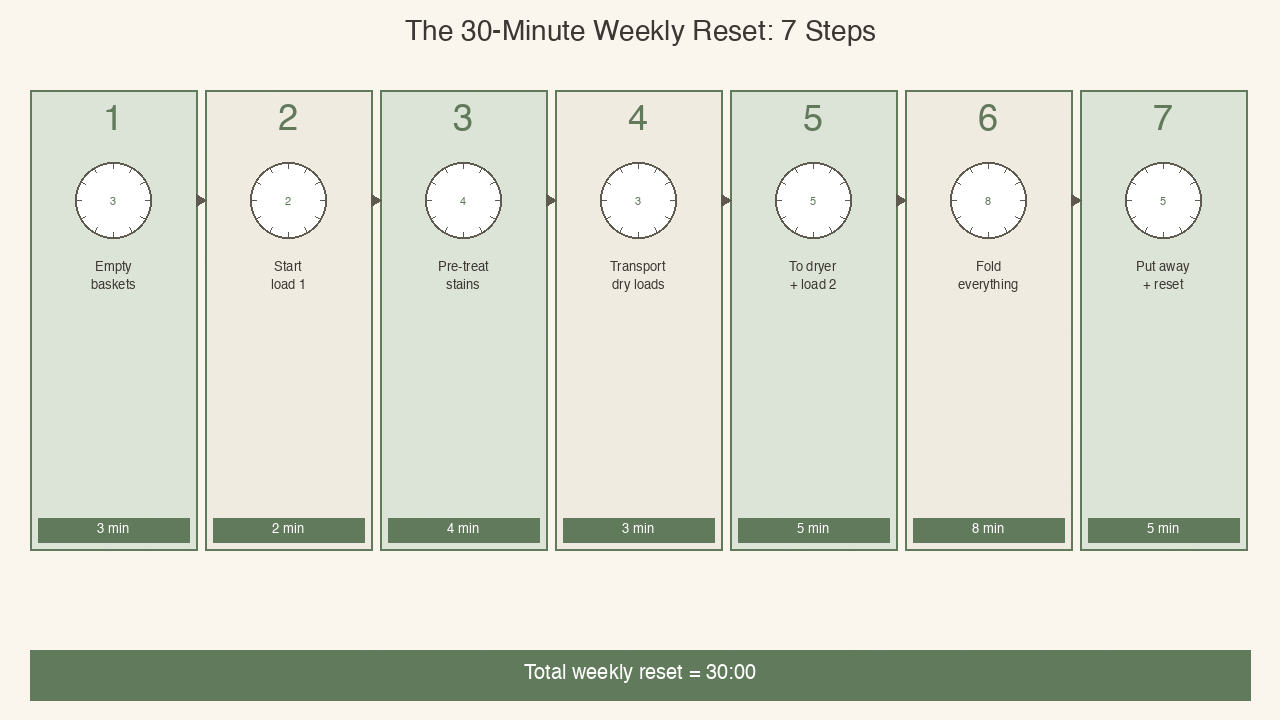
This is the spine of the article. Total budget: 30 minutes flat. Each step has a hard time cap.
Step 1 — Empty Baskets Into the Sort Station (3 Minutes)
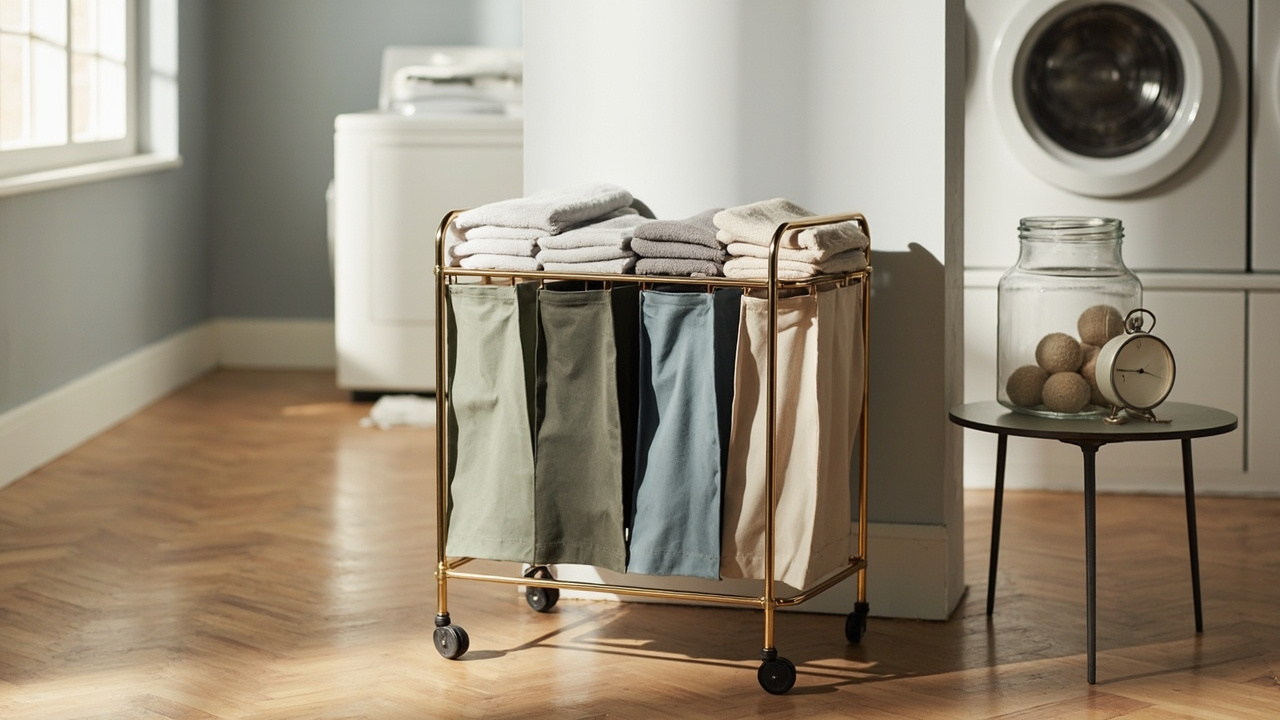
Pull every laundry basket, chair-pile, and stray sock from the route between bedrooms and the laundry zone. Dump contents into the STO STO 4-Section Sorter Cart’s four pre-labeled sections (darks / lights / socks-underwear / towels). The four-section design eliminates the sort-after-dumping step that eats 10-15 minutes. Hard stop at 3:00.
Step 2 — Start the First Load (2 Minutes)
Load the lights section into the washer, dose detergent from the Mr. Pen-labeled jar. Start the cycle. During the wash, run Steps 3-4 in parallel — the wash cycle buys you 30-40 minutes. See Laundry Supply Storage for the full walkthrough.
Step 3 — Pre-Treat Stains (4 Minutes)
Walk the remaining three sort-station sections and apply Tide To Go stain remover pen to anything marked — collars, cuffs, kid’s clothes, work shirts. The pocket-pen format fits in your pocket so pre-treat happens at the basket. This single step prevents the “rewash after reset” pile-up.
Step 4 — Transport Previous Dry Loads (3 Minutes)
Any clean-but-unfolded load sitting from earlier in the week goes into the Bemkoo collapsible pop-up hamper and moves to the folding zone. Pop-up design collapses to 2.5” between reset days. Hard stop at 3:00 — anything still in transit is next week’s transport pile. Pair with the laundry folding station setup.
Step 5 — Move Wash to Dryer, Start Second Load (5 Minutes)
First wash cycle finishes around minute 12-15. Transfer to dryer with Handy wool dryer balls — six wool balls cut dryer time by roughly 25 percent. Start the second load. Air-dry overflow goes onto the Vikaqi wall-mounted drying rack, critical for rentals without a dryer in unit. See Laundry Dryer Zone for the full configuration.
Step 6 — Fold Everything Visible (8 Minutes)
Fold the first dryer load (now dry at minute 25-28) and any air-dried items from the rack. This step has no time extension. Anything still in the dryer at minute 28 is hung on the wall rack and folded next reset. The cap is what makes the routine sustainable — it forces the put-away step into the same 30-min window rather than letting it drift into the evening.
Step 7 — Put Away + Reset the Zone (5 Minutes)
Folded piles go to bedrooms / closets. Ironing board hangs on the Home Basics over-door ironing board holder. Empty the Secura timer for next week. Wipe down the washer top and dryer lid. For the iron station detail, see Laundry Iron and Repair Station. Reset is complete at minute 30.
Family-Size Cadences
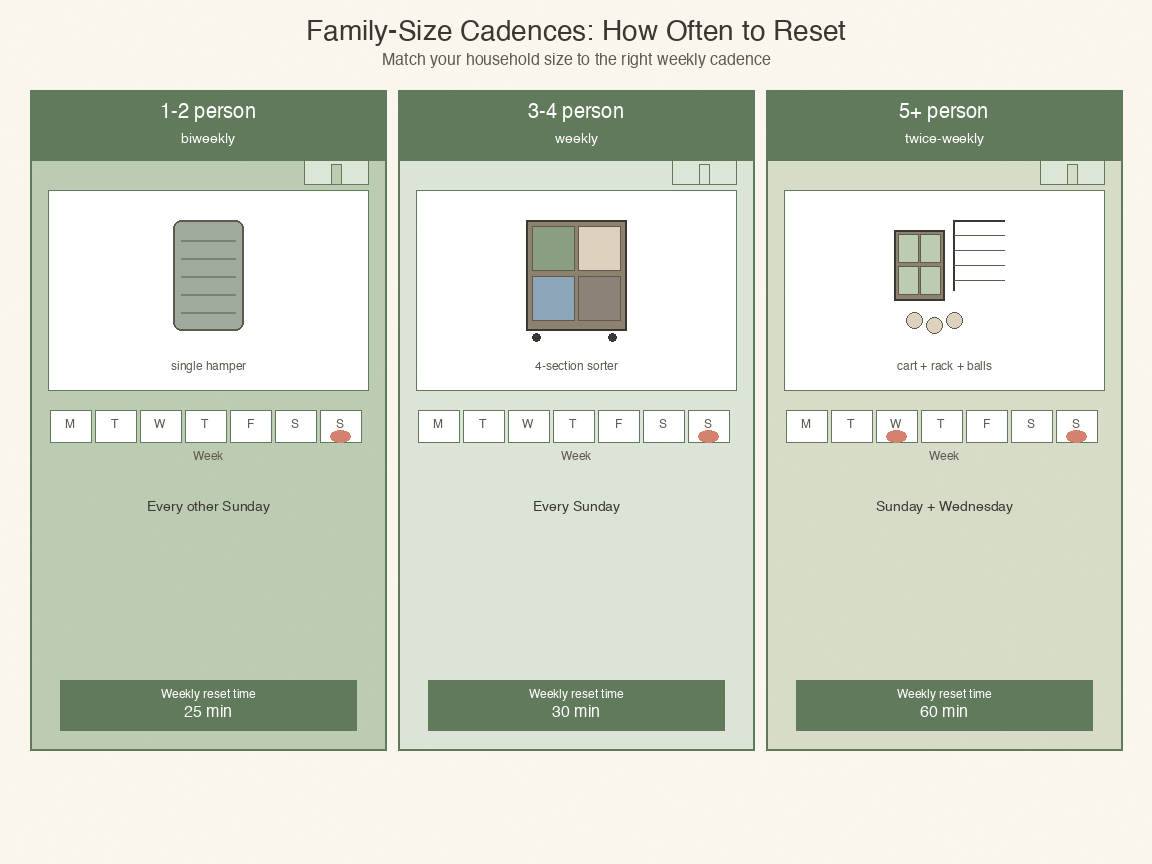
The 30-minute framework is constant, but how often you run it depends on household size. Pick the cadence that fits your family.
Cadence at a Glance
1-2 Person Households — Biweekly Reset
Two adults generate roughly 35-50 items per week. A 30-minute reset every other Sunday handles it, with one mid-week small wash only pass for underwear and towels. Total weekly time investment: about 25 minutes. Skip the 4-section cart — a single Bemkoo pop-up is enough.
3-4 Person Households — Weekly Reset (The Design Target)
This is the family size the routine is optimized for. 60-90 items per week, mixed adult plus kid loads. The 4-section STO STO sorter is the workhorse — one adult runs reset solo in 30 minutes, or two adults split it in 20 minutes together. Pair this cadence with Laundry Sort Station Setup.
5+ Person Households — Twice-Weekly Reset Plus Daily Maintenance
Five or more people means 100+ items per week. Run the full 30-min reset twice weekly (e.g., Sunday plus Wednesday), with a 5-minute daily pass that moves clean items to put-away zones. The wool dryer balls become essential — 25 percent dryer time savings multiplied by 8+ loads per week equals 2+ hours saved.
Constraint Guide
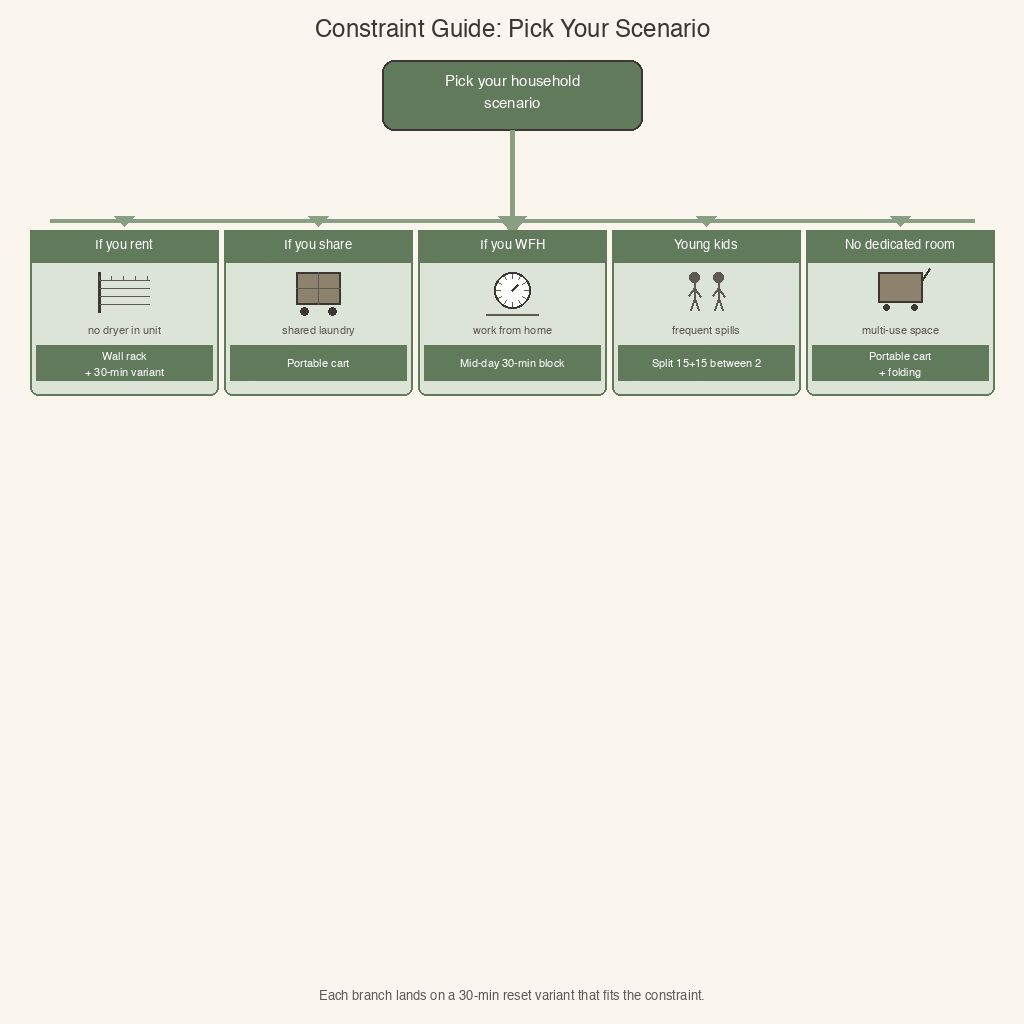
Pick the scenario that fits your household. Each branch maps the 30-min reset to a real constraint. Each scenario shows two or more product picks so the affiliate density stays honest to the actual decision you’d make in that branch.
Five Branches at a Glance
If You Rent (No Dryer in Unit) → Swap Step 5 for Rack-Only Drying
No dryer means the Vikaqi wall drying rack becomes the primary drying surface — install it before the first reset. Add 10 minutes to the budget for hang-and-fold, or split reset into two sessions. The Secura timer still paces the at-home half. See Small Laundry Room Organization for the broader pattern.
If You Share Laundry With Neighbors (Building/House) → Front-Load Sort
Building laundry means the machines are contested. Pre-sort everything Sunday morning so the moment a machine frees up, you load and start. The STO STO cart rolls to the building laundry room with the pre-sorted load inside — no re-sorting at the machine. The Secura timer tracks each load so you know when the dryer finishes without sitting in the basement.
If You Work From Home → Run Reset at 11am Tuesday
WFH households don’t have a “leaves the house” anchor for the reset. Pick a mid-week low-meeting block (Tuesday 11am works for most). The 30-min cap helps WFH — meetings interrupt before reset bleeds into the workday. The Secura timer on the desk makes the 30-min visible. Add a Bemkoo pop-up hamper by your office door to catch stray office-clothes for the next reset.
If You Have Young Kids → Split Steps 5-7 With a Partner
Toddler and preschool households can’t run a 30-min reset solo without interruption. Split the framework: one adult does Steps 1-5, the other does Steps 6-7 during kid nap or after bedtime. Both halves stay under 30 minutes individually. The Tide stain pen lives in the kitchen caddy so the partner doing Steps 1-5 catches the breakfast stains before they set. Pair this with the Secura timer so each half stays on its 30-min cap.
If You Have No Dedicated Laundry Room → The Cart IS the Room
Apartments without a laundry closet use the STO STO cart as a portable laundry zone. Wheels roll it to the bathroom or kitchen for wash, back to a bedroom corner for fold. Removable liner bags mean you never lift the whole hamper. Add the Vikaqi wall rack for air-dry overflow.
Daily, Monthly, and Quarterly Maintenance
The 30-min reset is the weekly spine. Maintenance cadences keep the routine from sliding back into pile-up.
Daily 5-Minute Pass (Every Day)
A 5-minute daily pass: move clean items from dryer to basket, fold-or-hang one small pile, reset the Secura timer for the next reset. This single daily habit is what makes the weekly reset possible — without it, the reset piles up. If we skip the daily pass three days running, the reset extends to 45 minutes and the system breaks down.
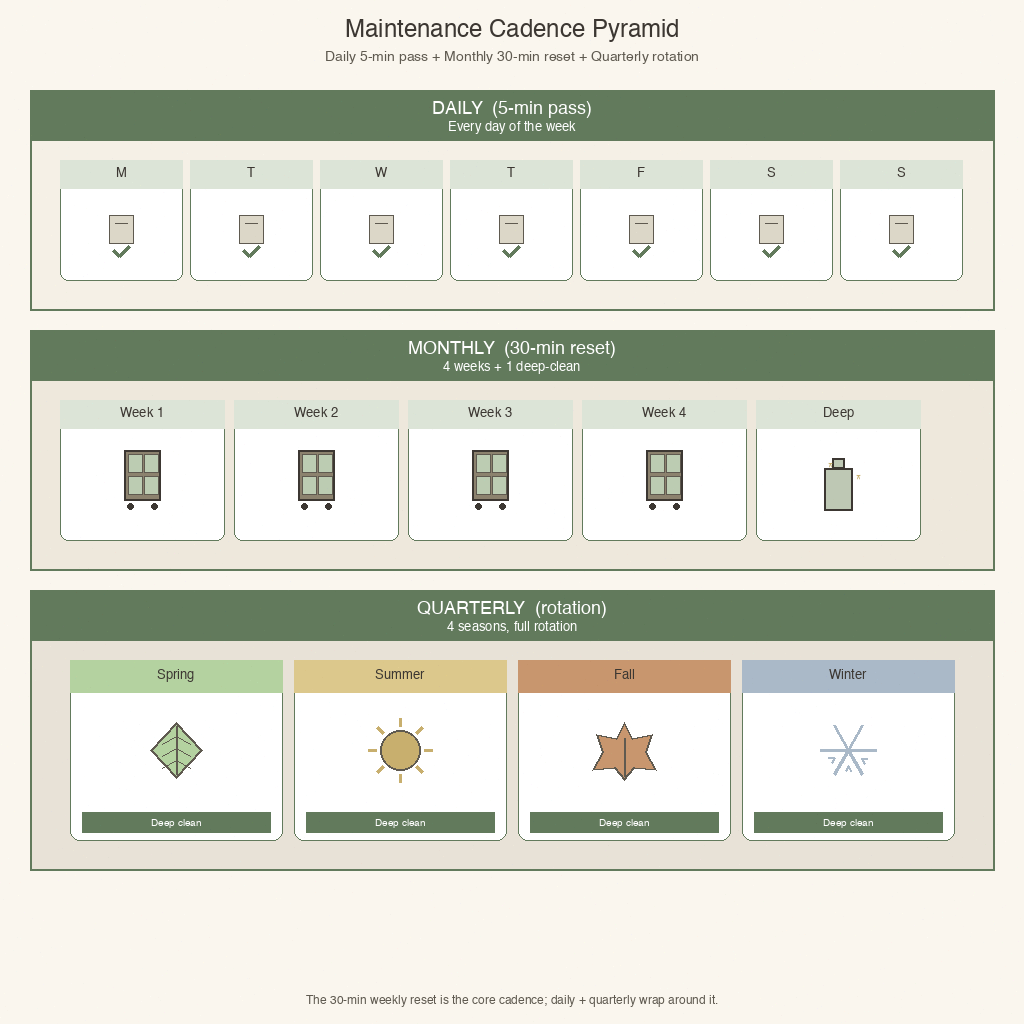
Monthly 30-Minute Deep-Clean (Last Sunday of Month)
Lint trap scrub, washing-machine Affresh cycle, dryer vent check, sort-station liner wash, wool dryer balls re-set (they compact over time). Monthly deep-clean catches the failures that cause the weekly reset to feel harder each week.
Quarterly Rotation (4× Per Year)
Rotate seasonal clothes in and out, refill detergent stock, replace Mr. Pen labels that have worn off, check the Vikaqi drying rack wall anchors for torque. One quarter per season keeps the system from drifting. Pair with the Declutter Maintenance Routine for the broader pattern.
What You’ll Need
Eight products cover every family-size and constraint branch above. Pick based on your household shape, not on price alone — the wrong pick creates the “always-skipping-it” failure pattern.
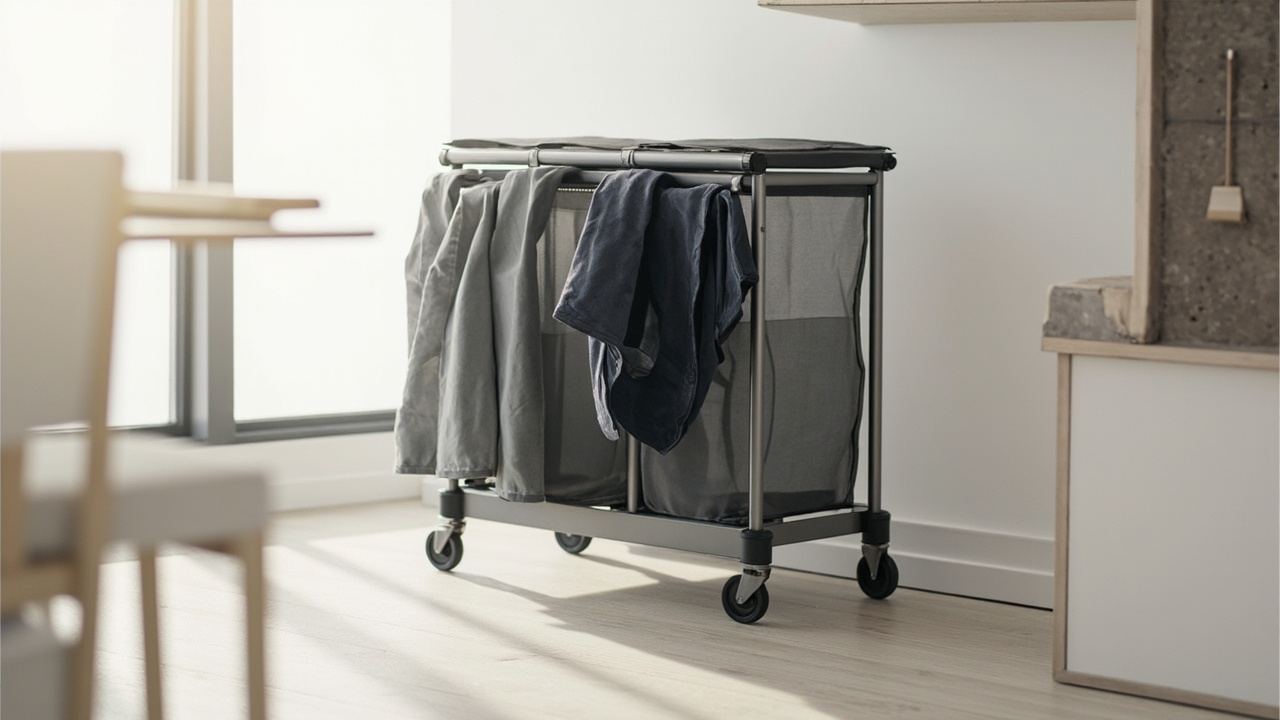
P1 — STO STO 4-Section 140L Rolling Sorter Cart — Sort Station Hero
The hero of this routine for 3-4 person households. Four pre-labeled sections eliminate the sort-before-wash step that eats 10-15 minutes in single-pile systems. Removable canvas liners go straight to the washer. View on Amazon — $44.99.
P2 — Bemkoo Collapsible Pop-Up Hamper — Budget Transport
Collapses flat between reset days. Side pocket holds dryer sheets for single-trip carry. View on Amazon — $9.99.
P3 — Vikaqi 32 inch Wall Mounted Drying Rack — Air-Dry Overflow (Rentals)
Wall-mounted foldable rack with 6 rods. Folds flat to 3 inches when not in use. Critical for rentals where the dryer isn’t in unit. View on Amazon — $59.99.
P4 — Home Basics Over-Door Ironing Board Holder — Finish Point (Budget)
Hangs over any interior door. Frees floor space and eliminates the where-do-I-store-the-ironing-board blocker. Pairs with Laundry Iron and Repair Station for the full iron setup. View on Amazon — $21.99.
P5 — Secura 60-Minute Visual Countdown Timer — Step Pacing (All Steps)
Mechanical 60-min countdown with visible disk. Step transitions stay on pace without checking a phone. View on Amazon — $18.99.
P6 — Handy Wool Dryer Balls 6-Pack — Drying Efficiency (5+ Person)
Six wool balls cut dryer time by roughly 25 percent. Replaces dryer sheets entirely. The leading time-budget gain for households running 8+ loads per week. View on Amazon — $12.99.
P7 — Mr. Pen Chalkboard Labels 100 pcs — Supply Identification (Budget)
100 chalkboard labels plus chalk marker cover pods, scent boosters, dryer sheets, mesh bags, and lost-sock bins. Waterproof so labels survive laundry-room humidity. View on Amazon — $4.85.
P8 — Tide Stain Remover Pen — Pre-Treat Spot (Constraint)
Pocket-sized instant stain remover. Forces pre-treat at the point of stain. Eliminates the rewash-after-reset pile-up cause. View on Amazon — $17.98 for a 6-pack (about $3 per pen).
Common Mistakes
Real failure cases from competitor warnings and Amazon 1-star patterns.
- Letting “One More Load” Pile Up Before Reset Day
Skipping reset “just this week” because the pile is small creates the 3-week mega-pile. Run the 30-min reset regardless of pile size. The Secura timer enforces the rule.
- Sorting at Reset Time Instead of Pre-Sorting as Clothes Enter the Hamper
Sorting 80 items at reset time eats the entire 30-min budget. The STO STO 4-section sorter is the fix — we pre-sort as we undress, so by Sunday morning the cart already has 80 sorted items waiting.
- Skipping the Fold Step (Wet Laundry in Dryer Overnight)
Wet laundry in the dryer overnight is the primary cause of “I have clean clothes but nothing to wear”. Step 6 must complete inside the 30-min budget. Anything left is hung on the Vikaqi drying rack and folded next reset.
- No Finish Point — Reset Routine Without “Put Away” Step Gets Repeated Next Week
Forgetting Step 7 means the next reset starts with a fold-and-put-away backlog. The Home Basics ironing board holder on the door is the visible “tools stowed” signal.
- Batching by Color Once Instead of by Load Size and Fabric Weight
Color batching creates 1-2 huge loads instead of 3-4 right-sized loads. Right-sized loads dry faster and fit the 30-min reset.
Related Guides
Three sister articles cover the broader Sort / Store / Dry / Fold / Iron workflow.
- Laundry Room Organization — the declutter-side 5-Stage method that pairs with this reset for households needing the deep-clean path between resets.
- Laundry Sort Station Setup — T4 howto covering the 4-section cart system in detail. Cross-link from Step 1.
- Laundry Supply Storage — T4 howto covering detergent, pods, and stain treatment storage. Cross-link from Step 2 plus the P7 / P8 affiliate section.
For the broader system context, see the laundry hub 5-stage overview.