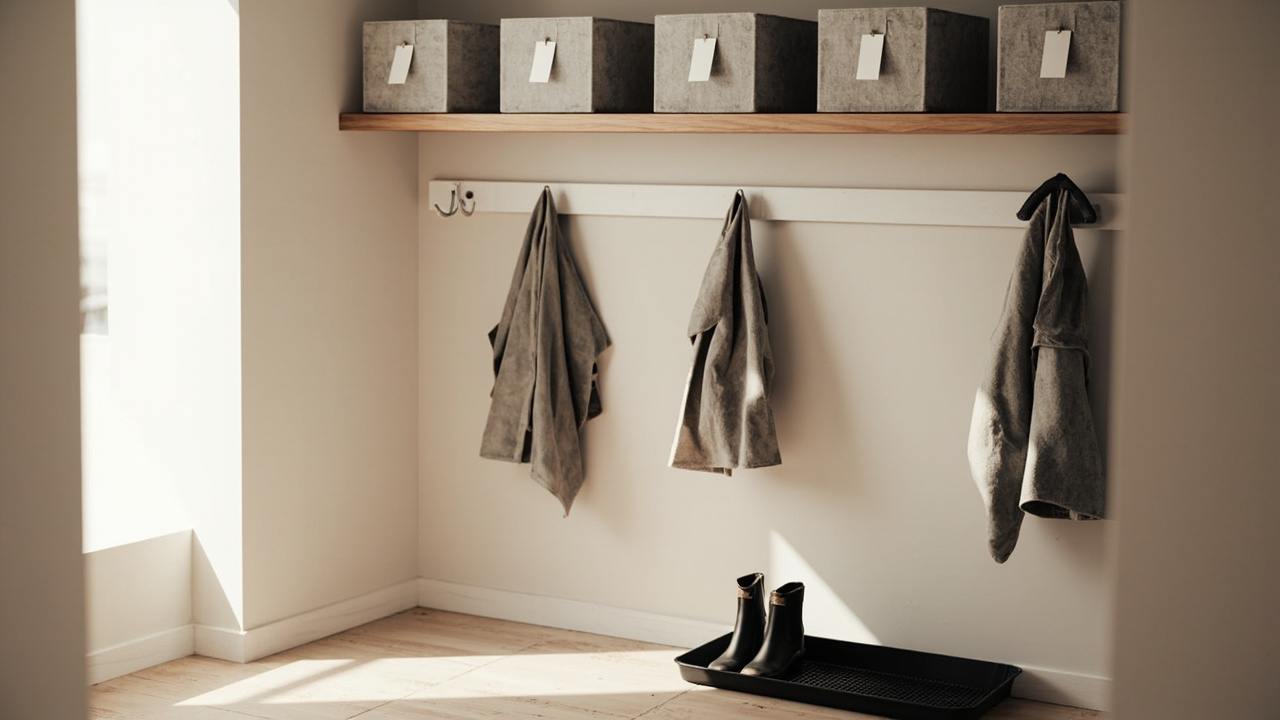
The entryway is the smallest high-traffic room in most homes, and it’s the one that gets asked to hold twelve months of gear in a space sized for one. Seasonal rotation is the fix: one season at a time on a fixed calendar, plus a single shelf with four marked bins.
Quick answer: Pick four swap dates — early October, early January, early April, early July. On each date, run a 30-minute five-step swap (clear, sort, clean, load-and-relabel, stage) using one labelled bin per season, one buffer basket for shoulder-season overlap, and a five-zone wall-to-floor staging plan. Dormant bins live outside the entryway within a minute’s walk.
For the broader system, start with the entryway organization hub and, if you’re starting from a packed entryway, clear the entryway once before you start rotating. we ran ours twice before the rotation method held, and the second pass is where the labels stopped getting rewritten.
Why seasonal rotation beats storing everything year-round
A family of four with four seasons of gear stores roughly 4× the hardware the entryway needs on any given day. Rotation cuts visible inventory to the current season plus one shoulder-season overlap, which is what most entryways were actually designed for. It keeps the room at its designed capacity year-round and forces every item through your hands four times a year, replacing the once-a-year purge nobody enjoys. we run the swap at the same four dates every year so the calendar, not the weather, drives the change.
The 4× inventory problem in a 3-foot-wide space
4 people × 4 seasons × (1 coat + 1 hat + 1 pair gloves + 1 pair boots) = 64 items. The in-season half is 16 items, which is what a 3-foot-wide entryway was built to display. The other 48 are dormant at any given time, and a “store everything” plan tries to surface all 64 at once. That’s where the chair pile, the buried hooks, and the boot tray full of flip-flops in January come from. The fix isn’t more furniture. It’s hiding two-thirds of the inventory in marked bins, one per season, somewhere other than the entryway.
Rotation as a built-in annual audit
Every quarter you touch every item, and that’s the quiet advantage over a once-a-year purge. Outgrown kids’ gloves, hats nobody wore, and broken zippers surface automatically because you handle each piece twice a year. A swap takes 30 minutes once the system is set up; budget 60 to 90 minutes for swap number one because you’re also deciding what belongs in each bin.
The four-season framework: 4 bins, 4 labels, 1 shelf
The method core is a one-to-one mapping between four calendar seasons and four marked bins that live on a single shelf somewhere outside the entryway. The set is the Amazon Basics Collapsible Fabric Storage Cube Bins with Handles, 13”, 6-Pack at $19.94 — four working bins plus two spares, and the empty half collapses flat. Labels are the Joyberg 150-Piece Removable Storage Bin Labels at $7.49, removable because the same bin changes identity twice a year.
What goes in each season bin
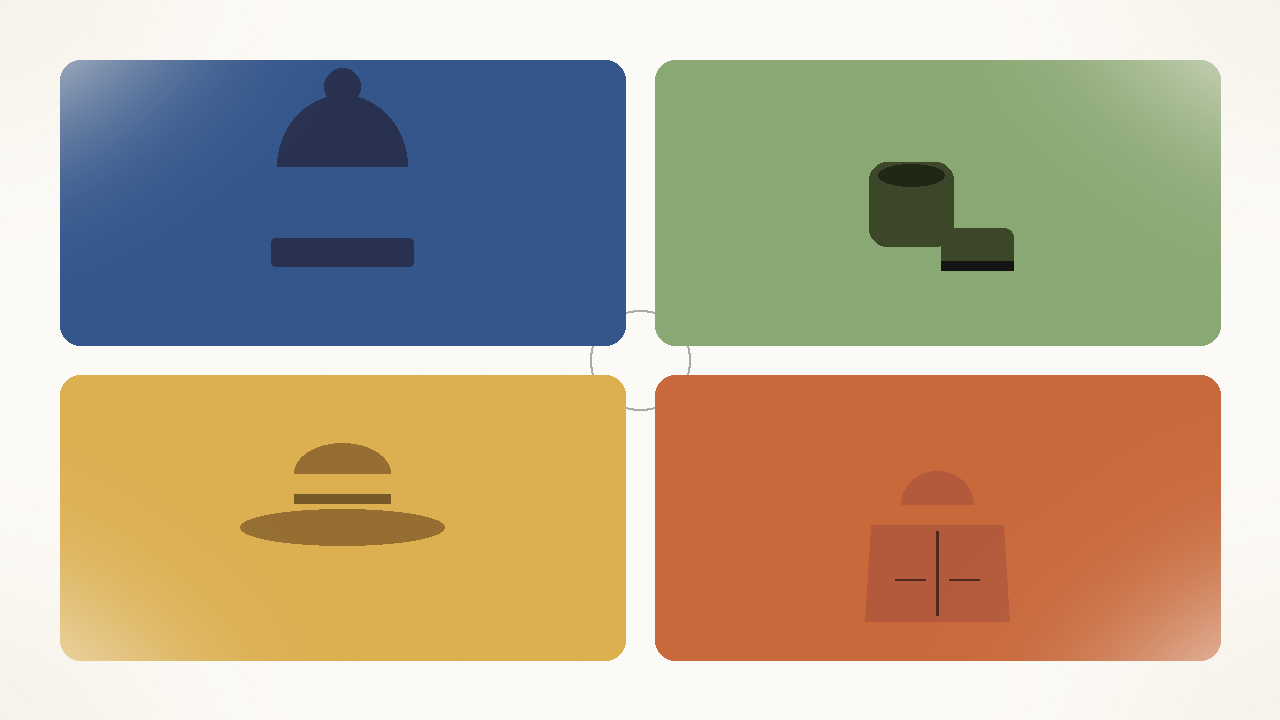
Winter holds insulated gloves, wool hats, scarves, and waterproof boots. Spring holds the rain shell, light gloves, and rain boots. Summer holds sun hats, caps, sandals, and sunscreen. Fall holds mid-weight layers, closed shoes, and a compact umbrella. Items that span two seasons — a light fleece, a soft-shell jacket — live in the buffer basket from Zone 5, not a duplicate in both bins. Choose either fabric or rigid plastic based on the fabric versus plastic for seasonal storage trade-off, then size the storage bins for a shared shelf.
The label system that survives four swaps a year
Every label carries three lines: season, household member initial, and last swap date. WINTER / M / 2026-10-05. The “last swap date” line prevents a 30-minute swap from turning into a 2-hour swap, because the question “when did I last touch this?” has a printed answer. we rewrite every label at every swap rather than reusing the old one, and that small habit is what keeps the system from sliding into a pile by summer.
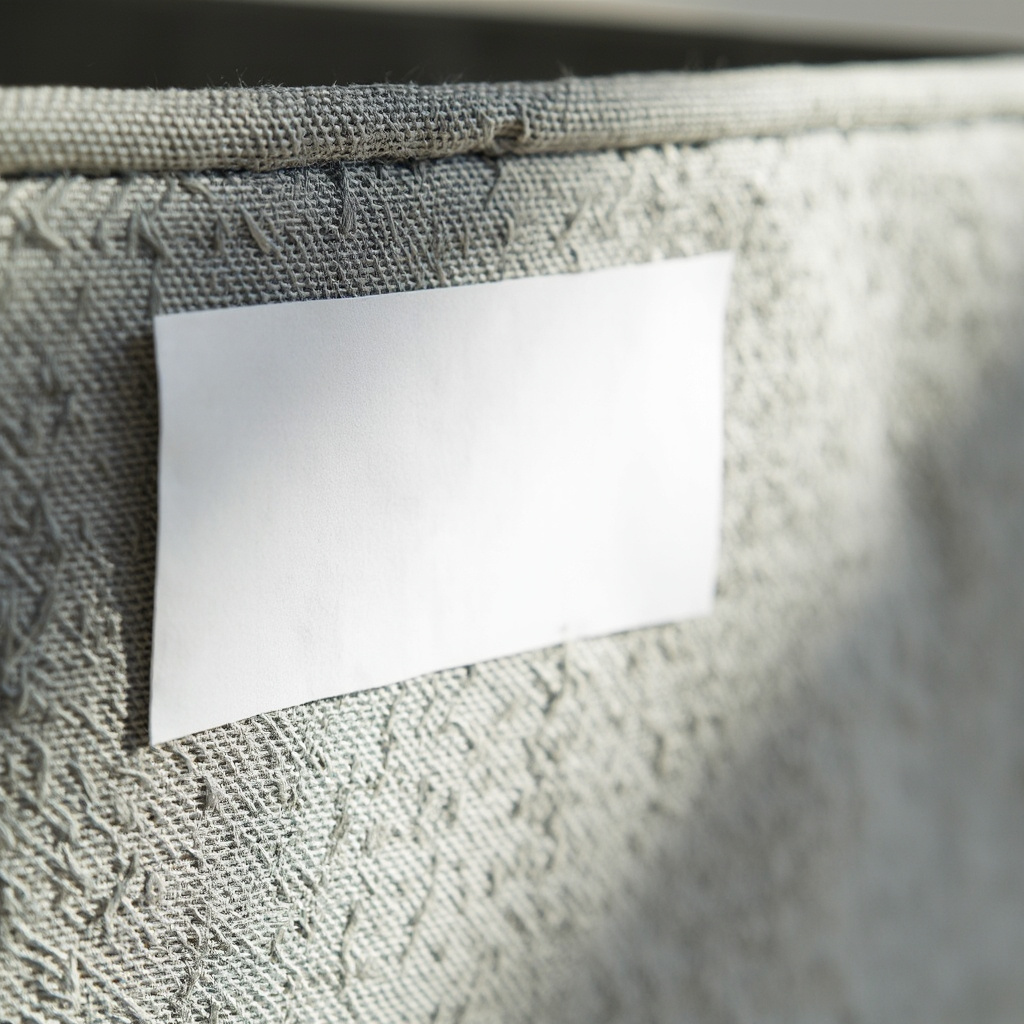
For the full label taxonomy and what survives moisture, see a labelling system that survives repeated relabelling.
Where the dormant bins actually live
Dormant storage must be outside the entryway, within 60 seconds’ walk. A closet top shelf, a garage rack, or under a bed all work. Collapsible fabric bins are a force multiplier here because the empty half of the year takes no shelf depth. Keeping dormant bins in the entryway itself defeats the rotation, because the room stays at 4× inventory and the system delivers nothing but extra containers. For entryways that genuinely have no nearby shelf, see where dormant season bins can live outside the entryway.
Five-zone staging for the in-season half
The current season’s gear maps onto five physical zones so the swap has a fixed destination for every item, running from wall hooks at the top of the room down to the floor tray. The five-zone map matches the entryway organization hub framework; the seasonal rotation method just makes each zone hold only the current season plus a thin shoulder-season overlap.
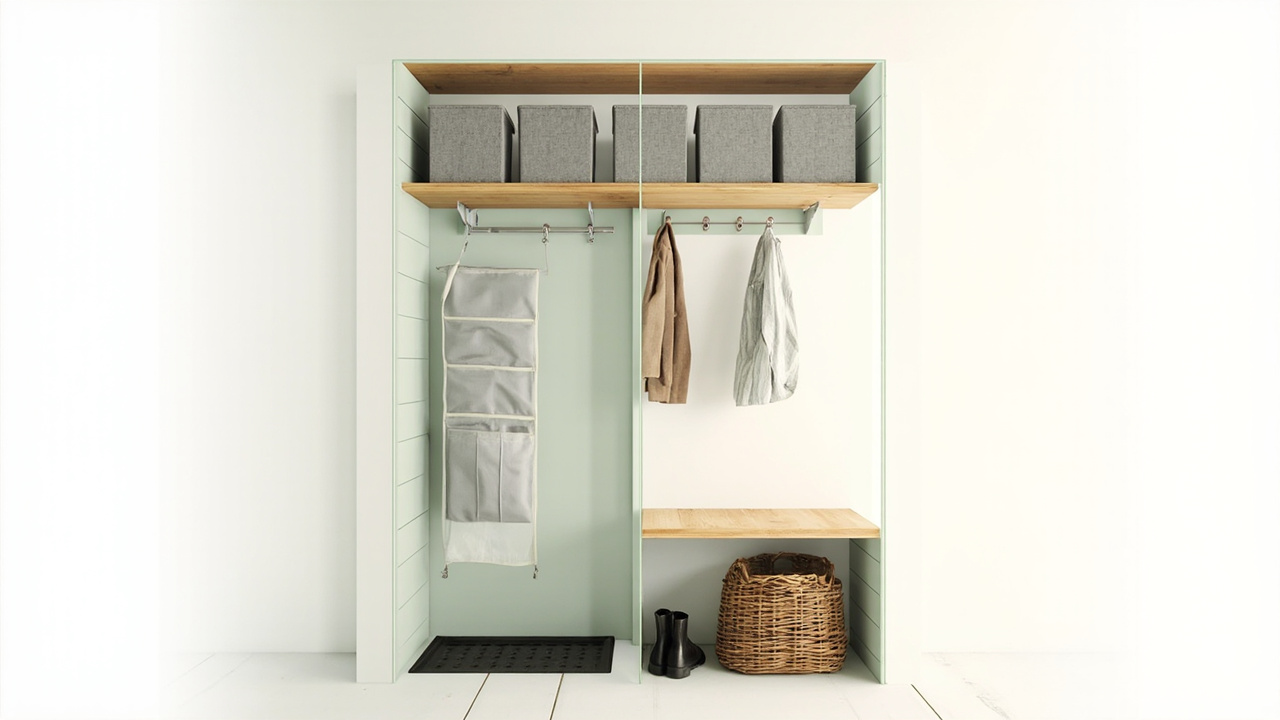
Zone 1 — Wall hooks for coats and daily layers
One rail per season is the trick. The AMADA HOMEFURNISHING Wall-Mount Coat Rack, 2-Pack, 15.7” White at $24.99 ships as a 2-pack so one bar stays empty for the two-week shoulder-season overlap and the second bar carries the current season. For hook placement, see choosing and placing coat hooks.
Zone 2 — Back of the door for small accessories
The Simple Houseware 24-Pocket Clear Over-the-Door Organizer, Gray at $13.97 gives two named pockets per person for gloves, scarves, and sun hats with no drilled hole. Households with more than a dozen caps should add the AOODA Clear Over-the-Door Hat Rack, Holds up to 72 Caps, 3 Hooks, Black at $19.99 to keep beanies and ball caps visible. Both hang without hardware, which is the only difference that matters for a renter.
Zone 3 — Floor for the season’s footwear
The Ottomanson 15” x 30” Multi-Purpose Boot Tray, Waterproof, 1.2” Raised Edge at $14.38 contains snow melt October through March, then empties and stores flat in April. The rule is one pair per person on the floor, the rest in the season bin. The deeper system for shoes and coats sharing one footprint is on the entryway shoes and coats organization sister page.
Zone 4 — Bench or console for the drop-and-go layer
Keys, sunglasses, one bag per person, the day’s launch-out kit. This zone does not rotate; it is daily. The deeper zone design is on the entryway drop zone and bench storage sister articles.
Zone 5 — Overflow shelf for the shoulder-season buffer
The two-week window where both seasons’ items are in play. Keep one buffer basket holding the items that span both seasons, rather than reopening the dormant bin every morning. When the overlap ends, the basket empties into whichever season bin is currently dormant.
The quarterly rhythm: what to do in October, January, April, and July
Four fixed dates — early October, early January, early April, early July — each with a named job and a 30-minute sequence. The January date is a 10-minute audit, not a full swap. This is the same quarterly rhythm applied to a seasonal clothes closet rotation, so the household learns one calendar.
Early October — the winter build-up
Pull the winter bin onto the floor, stage the boot tray, audit last winter’s gloves for holes, then compress the summer half into Amazon Basics Vacuum Storage Bags with Hand Pump, Large, 5-Pack at $13.12 before shelving it. Plan 60 minutes — winter has the most gear and the most cleaning.
Early January — the mid-winter audit
No full swap, just a 10-minute check. Replace lost gloves, re-pair boots, remove any holiday-season overflow. Mid-winter is when the system usually breaks because holiday volume piles onto an already-full season.
Early April — the winter breakdown
Wash and fully dry everything before it enters the bin. Damp wool in a sealed bin is the single most common rotation failure because mildew and permanent odour are the predictable result. Plan 45 minutes for the clean-and-dry step.
Early July — the summer simplification
The lightest swap of the year. Reduce the wall to a single rail, retire the door organiser’s lower rows, and donate anything untouched for two consecutive summers.
The five-step swap that fits in 30 minutes
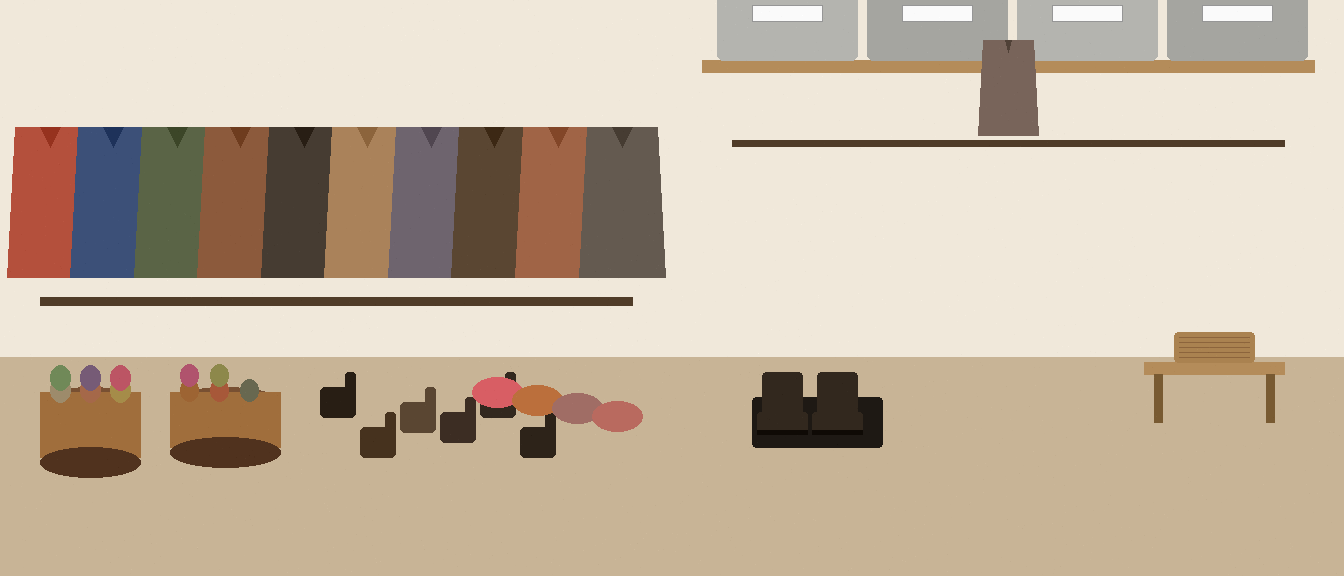
The shared procedure on all four dates: clear the zones (everything to the centre of the floor), sort into keep, repair, and donate, clean and dry, load and relabel the outgoing bin, then stage the incoming season. The five-minute daily reset is the daily layer that keeps a swapped entryway actually swapped.
What you’ll need
The four bins plus labels are the only non-optional purchase. Everything else depends on which zones the entryway actually has. For sizing, see sizing storage bins for a shared shelf and the hooks and racks for vertical storage guide for the wall side.
Core kit — bins and labels ($27)
The Amazon Basics Collapsible Fabric Storage Cube Bins with Handles, 13”, 6-Pack at $19.94 plus the Joyberg 150-Piece Removable Storage Bin Labels, 6” x 4”, Matte White at $7.49. Collapsible fabric beats rigid plastic because the empty half of the year takes no shelf depth; four rigid plastic totes would consume one full shelf year-round.
Zone hardware — hooks, pockets, and trays ($48 to $73)
The AMADA HOMEFURNISHING Wall-Mount Coat Rack, 2-Pack, 15.7” White at $24.99, the Simple Houseware 24-Pocket Clear Over-the-Door Organizer, Gray at $13.97, the AOODA Clear Over-the-Door Hat Rack at $19.99 for cap-heavy households, and the Ottomanson 15” x 30” Multi-Purpose Boot Tray at $14.38. Drop the hat rack if the household owns fewer than 12 caps.
Optional — compression for bulky winter gear ($13)
The Amazon Basics Vacuum Storage Bags with Hand Pump, Large, 5-Pack at $13.12 only if coats and snow pants are involved. Trade-off: vacuum bags crush loft, so down items should be re-fluffed for a day after unpacking.
Constraint Guide
Five if-then branches for entryways that aren’t a standard 3-foot-wide wall in a single-family home.
If you rent and cannot drill
Use the Simple Houseware 24-Pocket Clear Over-the-Door Organizer and the AOODA Clear Over-the-Door Hat Rack, which hang over the door frame, plus a freestanding coat rack instead of the AMADA wall-mounted coat rack. Adhesive hooks fail under wet winter coats — they look fine in October and snap off in January.
If the entryway is under 20 square feet
Drop to two bins (cold half, warm half) and two swaps a year instead of four. Compress the dormant half with Amazon Basics Vacuum Storage Bags. The full system for entryways under 20 square feet is a sister guide.
If there is no closet or shelf for dormant bins
Store dormant bins vertically under the bench or on a high shelf in the nearest room. Never store them in the entryway itself — that defeats rotation. Collapsible fabric bins are the workaround that makes “no shelf” workable because the empty half folds to a 2-inch slab.
If four people share one entryway
One labelled bin per person per half-year rather than per season, so the label reads WINTER / M instead of WINTER / SHARED. The AMADA two-rail coat rack becomes four named hook ends, the Simple Houseware 24-pocket over-door becomes six pockets per person, and the swap still runs 30 minutes.
If kids’ sizes change mid-season
Add a small outgrown basket to Zone 5 and empty it at each swap into donate or hand-me-down. Do not put outgrown gear back in the season bin — that’s how bins slowly fill with items nobody can wear, and four swaps later you discover last winter’s gloves in the summer bin.
Common Mistakes
Five real failure modes that break the rotation system, with the fix for each.
-
Storing damp boots and wool in a sealed bin — Mildew and permanent odour. Fix: 24 hours of air-drying before the bin closes, and leave the lid slightly ajar for the first day of storage. This is the single most common reason a seasonal rotation system fails by year two.
-
Skipping the label because “I’ll remember” — Every swap becomes an excavation. Fix: use the Joyberg removable labels with season, initial, and swap date, and rewrite at every swap rather than reusing. A label is the cheapest insurance against a 30-minute swap turning into a 2-hour dig.
-
Keeping dormant bins in the entryway — The room stays at 4× inventory and the rotation delivers nothing. Fix: dormant storage lives in another room, ideally within 60 seconds’ walk.
-
Swapping on a weather trigger instead of a date — Waiting for the first snow means swapping in a rush at 7 a.m. on a school day. Fix: fixed calendar dates with reminders set 48 hours in advance, weather-independent.
-
Rotating gear but never auditing it — Bins get heavier every year with broken zippers and single gloves. Fix: keep, repair, and donate is step two of the swap, not optional. The deeper pattern for building a maintenance routine that survives a busy season is a learn-collection sister guide.
Maintenance cadence
Four layers, in order of frequency. The daily and weekly layers are what make the quarterly swap take 30 minutes instead of three hours.
| Cadence | What runs | Time |
|---|---|---|
| Daily | 30-second reset of Zone 4 (drop-and-go layer) | 30 seconds |
| Weekly | Return strays to their named zone, refill the launch-out kit | 5 minutes |
| Monthly | Pair up single gloves, check boot tray for wear | 10 minutes |
| Quarterly | The full five-step swap | 30 minutes |
The daily and weekly layers live in the five-minute family entryway reset sister guide, which covers the Clear / Sort / Reset / Sanity Check / Tomorrow Prep routine.
Related
- Entryway organization hub — the 4-zone framework
- Entryway family reset — the 5-minute daily reset
- Seasonal closet rotation — the same quarterly rhythm for the clothes closet
- Small entryway organization — the 2-bin, 2-swap fallback